
Eat That Frog by Brian Tracy
 wkadmin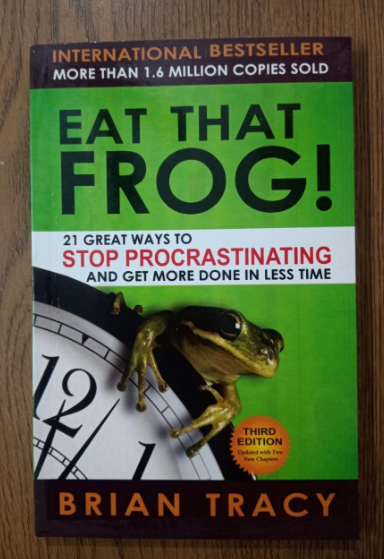
📖 Introduction: Why This Book Matters?
Imagine standing at the edge of your day, staring at a mountain of tasks that seems to grow taller by the hour. You know what needs doing, but somehow the hours slip away, and the most important work remains untouched. Sound familiar? This book cuts through the noise with a brutally simple premise: if you had to eat a live frog every morning, wouldn’t you want to get it over with first thing? That frog represents your biggest, ugliest, most important task—the one you’re most likely to procrastinate on, yet the one that would make the greatest difference in your life.
This matters because we’re drowning in distractions while starving for results. Tracy’s approach isn’t about doing more things—it’s about doing the right things, consistently, without excuse. In a world obsessed with productivity hacks and life optimization, this book strips everything down to one fundamental truth: success comes from the disciplined execution of your most valuable activities, day after day, no matter how you feel.
👥 Who Should Read This
Chronic procrastinators who know exactly what they should be doing but find themselves cleaning their desk, checking emails, or scrolling through social media instead. Overwhelmed professionals buried under endless to-do lists who finish each day exhausted yet feeling like they accomplished nothing meaningful. Entrepreneurs and business owners struggling to focus on revenue-generating activities instead of getting trapped in busywork. Students facing important projects but somehow finding time for everything except what matters most. Anyone who’s ever said “I’ll do it tomorrow” and watched their dreams slip further away with each passing day.
🔍 The Author’s Journey
Brian Tracy didn’t start at the top. He began as a high school dropout working labor jobs, washing dishes, and struggling to make ends meet. Through years of self-education and relentless self-improvement, he transformed himself into one of the world’s leading authorities on personal and professional development. His journey from poverty to becoming a successful businessman, consultant, and speaker who’s trained millions worldwide gives his advice a grounded, been-there-done-that authenticity.
What makes Tracy’s perspective unique is that he built his success through systematic application of the principles he teaches. He didn’t inherit wealth or luck into success—he engineered it through discipline, focus, and the very time management strategies he now shares. His work spans over four decades, and this book distills his most powerful insights into a framework that anyone can use, regardless of their starting point.
🔑 Key Model/Framework from the Book
The ABCDE Method: A prioritization system that forces ruthless honesty about what truly matters.
- A Tasks: Must do—serious consequences if not completed (your frogs)
- B Tasks: Should do—mild consequences if not completed
- C Tasks: Nice to do—no consequences if not completed
- D Tasks: Delegate—can be done by someone else
- E Tasks: Eliminate—waste of time, stop doing them entirely
The 80/20 Rule Applied to Time: Twenty percent of your activities will account for eighty percent of your results. Your job is to identify that crucial 20% and make it your obsession.
Sequential vs. Simultaneous Thinking: Plan your day the night before, identify your biggest frog, then attack it first thing with complete focus. No multitasking, no distractions—just concentrated effort on the one thing that moves the needle.
📊 By the Numbers
- 10% of time spent planning saves up to 90% in execution time
- The average person gets 1 interruption every 8 minutes, meaning about 7 interruptions per hour, destroying deep work capacity
- Most people work at only 50% of their potential capacity due to poor time management
- The first 3 hours of the workday are typically when people are most productive and mentally sharp
- It takes an average of 23 minutes to refocus after a distraction
- People who write down their goals are 10 times more likely to achieve them than those who don’t
💡 Key Takeaways
Tackle Your Biggest Challenge First: The frog-eating metaphor isn’t subtle, and it shouldn’t be. Your first task of the day should be the one you’re most tempted to avoid. Why? Because willpower and mental energy are finite resources that deplete as the day wears on. Attack your hardest work when you’re fresh, and everything else becomes easier by comparison.
Clarity Is Power: Most people fail not because they’re lazy but because they’re unclear. If you can’t identify your most important task in five seconds, you don’t have a priority problem—you have a clarity problem. Get crystal clear on your goals, then ruthlessly eliminate everything that doesn’t serve them.
Single-Tasking Is the New Superpower: In a world addicted to multitasking, the ability to focus on one thing completely has become a competitive advantage. Every time you switch tasks, you pay a cognitive switching cost. Stop paying it.
Preparation Prevents Poor Performance: Five minutes of planning before a task can save hours of wandering. Plan each day the night before, and you’ll wake up with purpose instead of confusion.
Perfect Is the Enemy of Done: Perfectionism is just procrastination in a fancy disguise. Your first draft doesn’t need to be brilliant—it just needs to exist. You can’t edit a blank page.
Counterintuitive Insights
Working longer doesn’t mean working better. Tracy argues that the person who works 60 unfocused hours achieves less than the person who works 40 laser-focused hours on the right activities. It’s not about time invested—it’s about attention directed.
Saying “no” is more important than saying “yes”. Every time you say yes to something unimportant, you’re saying no to something that matters. Your success depends more on what you refuse to do than on what you agree to do.
Starting is more important than succeeding. The biggest barrier isn’t failure—it’s never beginning. Once you start, momentum builds. Perfection kills progress before it even starts.
🧠 Myth-Busting Moments
MYTH: “I work better under pressure”
REALITY: You don’t work better under pressure—you just work faster with lower quality. What you’re really saying is, “I need the pain of a deadline to overcome my procrastination.” This is self-sabotage dressed up as a work style. The stress hormones that make you feel productive are actually impairing your judgment and creativity.
MYTH: “I need to clear small tasks first to focus on big ones”
REALITY: Small tasks multiply to fill available time. By clearing your inbox or organizing your desk first, you’re using productive procrastination—doing easy things to avoid hard things. The small stuff will still be there after you eat your frog, but you’ll have achieved something meaningful.
MYTH: “I don’t have time to plan”
REALITY: Not planning doesn’t save time—it wastes it spectacularly. Every minute spent planning saves ten in execution. The person “too busy” to plan is like the lumberjack too busy cutting wood to sharpen his saw.
MYTH: “Multitasking makes me more productive”
REALITY: Human brains can’t actually multitask—they rapidly switch between tasks, and each switch costs you time and mental energy. You’re not being productive; you’re being busy. There’s a massive difference.
💬 Best Quotes from the Book
“If you have to eat two frogs, eat the ugliest one first.”
This reminds us that when facing multiple daunting tasks, tackle the most challenging one immediately—it makes everything else feel easier.
“There is never enough time to do everything, but there is always enough time to do the most important thing.”
A powerful reframe that shifts focus from time scarcity to priority clarity.
“Every minute you spend in planning saves ten minutes in execution.”
The mathematics of success boiled down to one sentence.
“The hardest part of any important task is getting started on it in the first place.”
Once you begin, the psychological resistance crumbles.
“Your ability to select your most important task, to begin it, and then to concentrate on it single-mindedly until it’s complete is the key to great success.”
The entire productivity philosophy in one sentence.
🚀 Actionable Steps: How to Apply It Today?
Morning Ritual Redesign: Tonight, before bed, identify your ONE most important task for tomorrow. Not five tasks. Not three. One. Write it down. When you wake up, before checking your phone or email, work on that task for at least 90 minutes of uninterrupted focus.
The ABCDE Overhaul: Take your current to-do list and ruthlessly categorize every item using the ABCDE method. Be honest—most of your list is probably C, D, or E items masquerading as priorities. Cross out everything that’s not an A task, delegate the D tasks, and schedule focused time blocks for your A tasks only.
Create Your Forcing Function: Set a timer for 25 minutes (a Pomodoro) and commit to working on your frog with zero distractions. Turn off notifications, close unnecessary tabs, put your phone in another room. Just you and the task. When the timer goes off, take a 5-minute break, then repeat.
Evening Planning Session: Spend 10 minutes each evening planning the next day. Identify your frog, list your A tasks, and visualize yourself completing them successfully. This primes your subconscious mind to work on solutions while you sleep.
The Two-Minute Rule: If a task takes less than two minutes, do it immediately. If it takes longer, schedule it or delegate it. Stop letting small tasks accumulate into mental clutter.
Track Your Progress: Keep a “frog journal” where you log each day’s biggest accomplishment. Over time, you’ll see patterns in your productivity and proof that this method works.
⚡ First 24 Hours Action Plan
Hour 1 (Morning): Wake up and review the single most important task you identified last night. Don’t check your phone. Don’t browse social media. Just review your frog and mentally prepare to attack it.
Hours 2-4: Eat your frog. Work on your most important task with complete focus for 90-120 minutes. No exceptions, no excuses, no distractions. This is your sacred time.
Hour 5: Take a real break. Move your body, get fresh air, hydrate. You’ve earned it by doing what matters most.
Hours 6-8: Handle your B tasks and necessary communications. Respond to emails, attend meetings, deal with logistics. Now that your frog is eaten, these won’t feel like distractions—they’re just part of the workflow.
Hour 9 (Evening): Review your day. Did you eat your frog? If yes, celebrate that win, no matter what else happened. If no, analyze why without judgment and recommit to tomorrow.
Hour 10 (Before Bed): Identify tomorrow’s frog using the ABCDE method. Write it down clearly. Visualize yourself completing it successfully. Your subconscious will start working on it while you sleep.
Hours 11-24: Sleep well, knowing you’ve planted the seed for tomorrow’s success. Rest is not wasted time—it’s preparation for peak performance.
🤔 Final Thoughts
Is this book worth reading? Absolutely, but not for the reasons you might think. It won’t teach you some secret productivity hack that makes work effortless. Instead, it tells you the uncomfortable truth: success requires doing hard things you don’t want to do, consistently, without drama or excuses. The genius of Tracy’s approach is its brutal simplicity—there’s nowhere to hide, no complexity to blame for your lack of progress.
What makes this book powerful is that it forces you to confront your own patterns of avoidance. You can’t read it and claim you don’t know what to do. The strategies are clear, the application is straightforward, and the results are measurable. If you’re still not getting results after reading this, the problem isn’t the method—it’s your commitment to following it.
The writing style is direct, sometimes repetitive, but that’s intentional. Tracy hammers home the same core principles from multiple angles because knowing what to do and actually doing it are two different things. This book is a tool for the latter.
⭐ Rating: 4.2/5
| Aspect | Rating | Why? |
|---|---|---|
| Usefulness | ⭐⭐⭐⭐⭐ | Immediately applicable strategies that work in any profession or life situation. No fluff, just actionable tactics. |
| Readability | ⭐⭐⭐⭐ | Clear and straightforward, though somewhat repetitive. Tracy’s style is more practical than literary, which serves the content well. |
| Originality | ⭐⭐⭐ | The principles aren’t revolutionary—they’re time-tested wisdom repackaged effectively. The frog metaphor is memorable, but the underlying concepts are familiar. |
| Impact | ⭐⭐⭐⭐⭐ | Can genuinely transform your productivity if you actually apply it. The simplicity is what makes it powerful—there’s no excuse not to implement these strategies. |
| Practicality | ⭐⭐⭐⭐⭐ | As practical as it gets. You can start applying these methods within minutes of learning them. No special tools or resources required. |
| Timelessness | ⭐⭐⭐⭐ | Core principles remain relevant despite being written before smartphones dominated our lives. May need slight adaptation for modern distractions, but fundamentally sound. |
🎬 If This Book Were a Movie
Genre: Psychological thriller meets inspirational sports drama
Protagonist: Alex, a talented but chronically distracted professional drowning in potential but starving for results. They know what they’re capable of but can’t seem to translate knowledge into action.
Plot Arc: The film opens with Alex in crisis—a major deadline missed, an opportunity lost, a relationship strained by broken promises. Enter the mentor (embodying Tracy’s principles), who introduces the brutal challenge: “Every morning for 30 days, eat your frog first. No excuses.” We watch Alex struggle, fail, recommit, and gradually transform through the discipline of prioritized action. The climax isn’t a dramatic showdown but a quiet moment of Alex completing a long-delayed project that changes everything.
Supporting Characters:
- The Distraction Devil: A physical manifestation of all the small tasks and interruptions that seduce Alex away from important work
- The Committee of Excuses: Inner voices representing different forms of resistance (perfectionism, fear, overwhelm)
- The Future Self: Appears in moments of doubt, showing Alex who they could become
- The Frog: Literally visualized as an increasingly large, unsettling amphibian that follows Alex everywhere until eaten
Ending: Alex doesn’t become superhuman, but competent and consistent—the true superpower. The final scene shows their simple morning routine: coffee, notebook, timer set, frog eaten before 9 AM. Credits roll over a time-lapse of their steady progress over months.
🔄 Before & After Reading
BEFORE:
- Thinking: “I need to find the perfect productivity system/app/hack that will finally make me efficient.”
- Believing: “I work better under pressure” and “I just need more time to get things done.”
- Acting: Starting days by checking emails and social media, constantly switching between tasks, working long hours but making little meaningful progress, feeling perpetually behind.
- Feeling: Overwhelmed, guilty about procrastination, frustrated with lack of progress despite being busy all the time.
AFTER:
- Thinking: “I don’t need more time or better systems—I need to do the right things first, consistently.”
- Believing: “My success depends on my ability to identify and complete my most important task every single day, regardless of how I feel.”
- Acting: Planning the night before, identifying the one critical task, tackling it first thing with complete focus, saying no to distractions and low-value activities, finishing work on time with meaningful accomplishments.
- Feeling: In control, energized by visible progress, confident in the ability to handle important projects, less stressed despite achieving more.
The transformation isn’t about becoming a different person—it’s about becoming a disciplined version of who you already are.
📚 Books That Pair Well With This
“Deep Work” by Cal Newport: Takes the concept of focused, uninterrupted work even deeper. If Tracy teaches you what to work on, Newport teaches you how to work at your highest level.
“Essentialism” by Greg McKeown: Complements the frog-eating philosophy with a broader framework for eliminating the non-essential from every area of life, not just your task list.
“The One Thing” by Gary Keller: Doubles down on Tracy’s core message with a laser focus on identifying the single most important activity that makes everything else easier or unnecessary.
“Atomic Habits” by James Clear: Helps you build the systems and habits that make frog-eating a daily routine rather than a constant battle of willpower.
“Getting Things Done” by David Allen: Provides a more comprehensive organizational system for managing all the other tasks after you’ve eaten your frog.
📚 Resources
- Brian Tracy’s Official Website: briantracy.com for additional articles and courses
- Time Management Templates: Search for “ABCDE prioritization worksheet” for printable planning tools
- Focus Apps: Forest, Freedom, or Cold Turkey to block distractions during frog-eating sessions
- Pomodoro Timers: TomatoTimer.com or any 25-minute timer app
- Accountability Tools: Beeminder or StickK for adding stakes to your commitments
🤔 Skeptic’s Corner
The “Just Do It” Oversimplification: Tracy’s approach can sometimes feel like it ignores legitimate psychological barriers like anxiety, ADHD, or depression. While the strategies are sound, someone struggling with mental health issues might need additional support beyond “eat your frog.” Modern readers should recognize that sometimes the solution isn’t more discipline—it’s addressing underlying issues that make focus difficult.
The Corporate-Era Lens: Written before the gig economy explosion, remote work revolution, and always-on digital culture, some examples feel dated. The framework assumes a traditional work structure that many people no longer operate within. Adapt the principles to your reality rather than forcing your reality into the book’s examples.
The Intensity Problem: Tracy’s approach is intense and potentially unsustainable for some personalities. Not everyone thrives on high-discipline, structured approaches. Some creative professionals need more flexibility and chaos to do their best work. Use these principles as tools, not commandments.
The Work-Centricity: The book focuses heavily on professional productivity with less attention to life balance, relationships, or wellbeing. Remember that your biggest “frog” might sometimes be spending quality time with family or taking care of your health, not just career advancement.
The Individual Achievement Focus: In our increasingly collaborative world, Tracy’s individual-focused approach might need supplementing with team productivity strategies and communication skills.
🧑💼 How Real People Used It
Sarah, Marketing Director: “I was drowning in meetings and emails, never touching actual strategic work. I started blocking 7-9 AM for my frog—no meetings allowed. In three months, I completed the rebrand project that had been stalled for a year. My team now protects their mornings too.”
Marcus, Graduate Student: “My dissertation felt impossible until I applied the frog principle. Every morning, before classes or research, I wrote for 90 minutes on the most challenging chapter. Eighteen months later, I defended successfully. The secret was showing up daily, not waiting for inspiration.”
Jennifer, Entrepreneur: “I was constantly ‘busy’ but my revenue wasn’t growing. I used the ABCDE method and realized 80% of my tasks were C or D items. I delegated, eliminated, and focused only on client acquisition and product development. Revenue tripled in six months.”
David, Software Engineer: “Code refactoring was my frog—necessary but tedious. I committed to one hour every morning before checking Slack. Over a year, our codebase became maintainable again, and my stress levels dropped dramatically.”
🎯 3-Minute Challenge
Stop reading. Right now.
Grab whatever you’re writing with—phone, paper, laptop.
Minute 1: Write down the ONE task that, if completed tomorrow, would make the biggest positive impact on your life or work. Not three tasks. Not five. ONE.
Minute 2: List three specific actions you’ll take this week to move that task forward. Be concrete: “Monday 8 AM – spend 90 minutes drafting proposal” not “work on proposal.”
Minute 3: Text or message one person right now and tell them about your commitment. Accountability turns intention into action.
Your frog is identified. You know your first steps. Tomorrow morning, before you check anything, you’re eating that frog.
No excuses.
💬 Your Turn
You’ve just absorbed a framework that could genuinely transform your productivity. But here’s the truth: knowing and doing are separated by a massive canyon called implementation.
Will you be someone who nods along, feels inspired, then returns to the same patterns tomorrow? Or will you be someone who takes this one simple principle—eat your biggest, ugliest, most important task first—and builds a life around it?
The frogs are waiting. They’re not going anywhere until you face them.
What’s your frog for tomorrow morning?
Write it down now. Put this into action before the motivation fades.
Your future self is watching what you do next.