
The Millionaire Fastlane by M J DeMarco
 wkadmin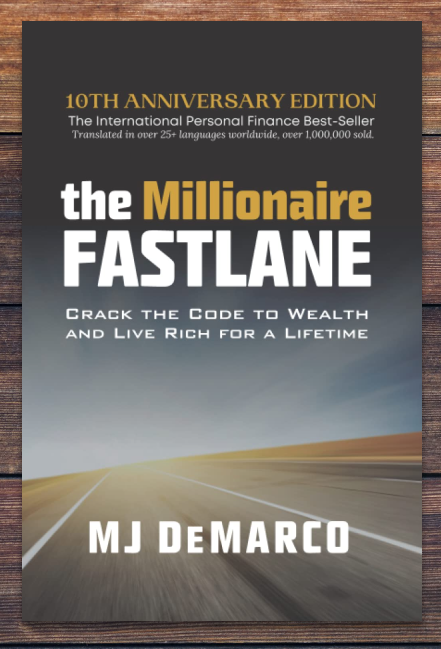
📖 Introduction: Why This Book Matters?
This book shatters the conventional wisdom about wealth creation. DeMarco doesn’t sell you the “get rich slow” dream of clipping coupons and sacrificing your youth for a comfortable retirement at 65. Instead, he presents a radical alternative: the Fastlane, a wealth-creation strategy that prioritizes building scalable business systems over trading time for money. This matters because millions of people are stuck in what he calls the “Slowlane”—working jobs they tolerate, saving pennies, and hoping mutual funds will somehow deliver freedom decades from now. DeMarco offers a blueprint for those who refuse to wait until they’re old to live rich.
👥 Who Should Read This
Aspiring entrepreneurs who feel trapped in the 9-to-5 grind. Anyone who’s tired of financial gurus preaching frugality as the path to wealth. Young professionals questioning whether the traditional career ladder actually leads anywhere meaningful. Side hustlers looking to scale beyond trading hours for dollars. People who’ve achieved some success but realize they’re still stuck on a treadmill. If you’ve ever thought “there has to be a better way,” this book is your wake-up call.
🔍 The Author’s Journey
M.J. DeMarco wasn’t born with a silver spoon. He spent his twenties driving a limousine in Chicago, observing wealthy clients while he scraped by. A chance encounter with a young millionaire in a Lamborghini sparked his obsession: how do people get wealthy young? He rejected the conventional path and built his first internet company in the late 1990s, eventually selling it for millions in his thirties.
His journey wasn’t linear—he faced failures, near-bankruptcy, and countless setbacks. But through trial and error, he decoded the pattern: wealth doesn’t come from jobs or stock market returns. It comes from creating systems that generate value at scale. After achieving financial freedom, he wrote this book to share the roadmap others could follow, challenging the mainstream financial advice industry that profits from keeping people in the Slowlane.
🔑 Key Model/Framework from the Book
The Three Roadmaps to Wealth:
- The Sidewalk – Living paycheck to paycheck, prioritizing instant gratification, no financial plan. Wealth equation: Income = Job. Time investment: Zero (just reacting to life).
- The Slowlane – The traditional path: get a job, max out 401(k), live frugally, invest in index funds, retire at 65. Wealth equation: Wealth = Job + Market Returns. Time investment: 40+ years of sacrifice.
- The Fastlane – Building scalable business systems that create value for millions. Wealth equation: Wealth = Net Profit + Asset Value. Time investment: 5-10 years of focused intensity.
The Five Fastlane Commandments (CENTS):
- Control: You must control your business and income sources
- Entry: High barriers to entry protect your business from competition
- Need: Solve real problems, don’t chase passions without market demand
- Time: Detach your income from your time investment
- Scale: Your business must reach millions, not dozens
📊 By the Numbers
- 40-45 years: Average time people spend in the Slowlane before retirement
- 5-10 years: Potential Fastlane timeline to wealth
- 8% annual return: The optimistic stock market assumption most retirement plans rely on
- $3-10 million: The rough wealth target needed for true financial freedom
- Millions of units: The scale required for Fastlane success (customers, users, transactions)
- 10x multiplier: Business asset values often calculated as multiples of annual net profit
💡 Key Takeaways & Counterintuitive Insights
Time is your most valuable asset, not money. The Slowlane trades decades of your youth for potential comfort in old age. That’s a terrible deal. Fastlaners recognize that youth and time are irreplaceable, so they build systems that create wealth quickly rather than gradually.
“Do what you love” is dangerous advice. Passion without market need leads to broke dreamers. Fastlaners flip this: find needs in the marketplace, solve them exceptionally well, and passion follows success. Love grows from mastery and impact, not the other way around.
Your job is a trap, not a opportunity. Even six-figure jobs limit your earning potential and keep you on a time-for-money treadmill. Fastlaners view jobs as temporary bridges to learn skills and save capital, not as destinations.
Frugality alone never creates wealth. Saving dollars while ignoring income growth is like trying to fill a swimming pool with a teaspoon. Fastlaners focus on exploding income through value creation, not penny-pinching.
Compound interest is overrated. The math sounds impressive, but starting with little money and waiting 40 years is a cruel joke. By the time “compound interest magic” works, you’re too old to enjoy it. Fastlaners use compound systems—business processes that multiply value exponentially.
The best time to start is when you have nothing. Being broke and young is an advantage, not a disadvantage. You have time, energy, and nothing to lose. The worst time to take risks is when you’re comfortable but trapped.
🧠 Myth-Busting Moments
MYTH: “Get a good education, land a good job, work hard for 40 years, and retire comfortably.”
REALITY: This worked for one generation (boomers) under specific economic conditions. Today, pensions are gone, jobs are unstable, and Social Security is uncertain. This path consumes your entire youth and vitality, gambling that you’ll be healthy enough to enjoy retirement. DeMarco calls this “hoping to be rich when hope is dead.”
MYTH: “Real estate and stocks are the proven path to wealth.”
REALITY: These are vehicles, not roads. Wealthy people use these to preserve wealth created elsewhere. Trying to get rich through investment returns with limited capital is mathematical insanity. You need wealth first, then you invest to maintain it.
MYTH: “Follow your passion and money will follow.”
REALITY: The graveyard of failed businesses is filled with passionate people who offered nothing the market needed. Fastlaners seek market problems desperate for solutions, then build passion through the journey of solving them at scale.
MYTH: “You need money to make money.”
REALITY: You need value-creation skills and willingness to serve needs. Many Fastlane businesses start with minimal capital. What you actually need is the ability to identify needs, create solutions, and reach customers—all learnable skills.
MYTH: “Entrepreneurship is risky; jobs are safe.”
REALITY: Jobs are high-risk—your income depends entirely on one entity that can fire you tomorrow. Business is controllable risk spread across many customers. Real safety comes from controlling your income sources.
💬 Best Quotes from the Book
“Stop thinking about business in terms of your selfish desires, whether it’s money, dreams or ‘do what you love.’ Instead, chase needs, problems, pain points, service deficiencies, and emotions.”
“Process over events. Events are the trappings of success—the wedding, the championship, the diploma. Process is the journey that got you there.”
“Slowlane millionaires live like they’re rich when they’re not. Fastlane millionaires live like they’re not rich even when they are.”
“Your choices have consequences. And these consequences accumulate.”
“Money is multiplied in volume and scale. To get rich, you need to impact millions.”
“The moment you trade your time for money, you put a ceiling on your income.”
🚀 Actionable Steps: How to Apply It Today?
Shift your mindset from consumer to producer. Every time you use a product or service this week, ask: “What need does this fulfill? How could it be better? What problems remain unsolved?” Train your brain to spot market gaps instead of just consuming.
Audit your time-for-money trades. Calculate your true hourly rate including commute time, preparation, and recovery. Face the brutal math: at your current rate, how long until you’re financially free? If the answer is “never” or “40 years,” you need a Fastlane vehicle.
Start building your Fastlane vehicle immediately. You don’t need a billion-dollar idea. Begin with service businesses that solve specific problems for specific people. Web design, consulting, software tools, information products—anything that can scale beyond your personal hours.
Apply the CENTS commandments to potential ideas. Before investing months into a venture, rigorously test it: Do you control it? Can competitors easily copy it? Does it solve a genuine need? Can you decouple time from income? Can it reach millions? Most ideas fail these tests.
Build systems, not jobs. If your business requires you to work 80 hours weekly forever, you’ve created an exhausting job, not a Fastlane asset. Systematize operations, hire people, create processes that run without your constant presence.
Focus on speed and iteration. Don’t spend years perfecting before launching. Get a minimum viable version to market quickly, gather feedback, improve rapidly. Fastlaners understand that execution beats perfection every time.
⚡ First 24 Hours Action Plan
Hour 1-2: Financial Reality Check Calculate your “freedom number”—the monthly passive income needed to cover your lifestyle. Then calculate how long your current path (job + savings + investments) will take to reach it. Write down that number. Feel the weight of it.
Hour 3-4: Roadmap Assessment Identify which roadmap you’re currently on. List every income source and whether it trades time for money. Be brutally honest. Most people discover they’re firmly in the Slowlane despite thinking otherwise.
Hour 5-8: Need-Finding Mission Spend these hours intentionally looking for needs. Browse forums, read product reviews, listen to people complain, examine businesses you frequent. Create a list of 20 unmet needs or problems people actively face. Don’t evaluate solutions yet—just identify pain points.
Hour 9-12: CENTS Filtering Take your 20 needs and run each through the CENTS commandments. Which ones offer control? Which ones have entry barriers? Which solve genuine needs? Which can decouple time from income? Which can scale? Narrow your list to 3-5 candidates.
Hour 13-16: Mini-Research Phase For your top idea, research existing solutions. Who’s serving this need now? What do customers complain about? What gaps exist? Is there evidence people pay for solutions? You’re not looking for empty markets—competition proves demand.
Hour 17-20: First Action Toward Building Take one concrete step toward creating your Fastlane vehicle. Register a domain. Create a landing page. Draft a service offer. Write an outline for an information product. Contact potential first customers. The step itself matters less than breaking inertia.
Hour 21-24: System Design Thinking Sketch out how your idea could eventually run without consuming all your time. What processes could be documented? What tasks could be delegated? How could technology handle repetitive work? This future-vision prevents building a glorified job.
🤔 Final Thoughts
This book delivers a psychological gut-punch that most people need. DeMarco writes with the bluntness of someone who’s already financially free and has nothing to sell you except reality. Yes, his tone can feel aggressive and the car metaphors get repetitive, but the core message deserves the intensity.
What makes this valuable isn’t groundbreaking business advice—plenty of books cover entrepreneurship. It’s the devastating critique of conventional wealth wisdom. DeMarco exposes how financial advisors, retirement planners, and “get rich slow” gurus profit from keeping you in the Slowlane. He shows the math proving that the traditional path is mathematically broken for wealth creation.
The book works as a deprogramming tool. If you’ve internalized the “save 10%, work 40 years, hope for the best” narrative, this book systematically dismantles it. Some readers will find this liberating; others will find it threatening because it demands taking responsibility.
Is every recommendation perfect? No. His dismissal of real estate and stock investing is overstated—these tools matter for wealth preservation. Some examples feel dated to the late 2000s internet boom. And his focus on “impact millions” might discourage people from profitable niche businesses.
But these are minor quibbles. The fundamental framework—producer vs. consumer, time vs. money, scale vs. limitation—remains powerful. This book gives you permission to reject the script society handed you and engineer a different path. That alone makes it essential reading.
Worth reading? Absolutely, especially if you’re under 40 and feeling trapped. Even if you don’t build a business, understanding these principles will transform how you view opportunities and make career decisions.
⭐ Rating: 4.2/5
| Aspect | Rating | Why? |
|---|---|---|
| Usefulness | ⭐⭐⭐⭐⭐ | Provides a complete mental model for wealth creation that most people never encounter. The CENTS framework alone is worth the read. |
| Readability | ⭐⭐⭐⭐ | Engaging and conversational, though sometimes repetitive. The car metaphors can feel overdone, but the message remains clear. |
| Originality | ⭐⭐⭐⭐ | Not entirely new ideas, but the combination and aggressive debunking of conventional wisdom feels fresh. Few books challenge retirement planning this directly. |
| Impact | ⭐⭐⭐⭐⭐ | Life-changing for the right reader at the right time. Many entrepreneurs credit this as the book that shifted their entire approach to wealth. |
| Practicality | ⭐⭐⭐⭐ | The framework is actionable, though execution details require additional learning. It tells you what to do (build scalable systems) but you’ll need other resources for the how. |
| Timelessness | ⭐⭐⭐⭐ | Core principles remain solid, though specific examples feel dated. The Sidewalk/Slowlane/Fastlane model transcends technological changes. |
🎬 If This Book Were a Movie
Protagonist: Marcus, a 29-year-old mid-level corporate analyst drowning in student debt, driving a used sedan, counting pennies while his company’s CEO flies private jets. He’s following every rule—saving 15% of his paycheck, contributing to his 401(k), living below his means—yet feels increasingly trapped.
Inciting Incident: At his boss’s retirement party, Marcus watches a 67-year-old man receive a gold watch and modest pension after 43 years of service. The retiree looks exhausted, not triumphant. That night, Marcus runs the math and realizes he’s on the same path.
Act One: Marcus discovers Fastlane thinking through a chance encounter with a young entrepreneur living the life he thought wasn’t possible. He begins seeing the matrix—the job is a trap, compound interest is a fairy tale, and conventional wisdom is designed to keep him comfortable but limited.
Rising Action: Marcus attempts his first Fastlane business while keeping his job. Early failures nearly break him. His family questions his sanity. His girlfriend delivers an ultimatum: stability or this crazy dream. He faces the choice between certain mediocrity and uncertain greatness.
Climax: After years of iteration, late nights, and near-bankruptcy, Marcus’s scalable business system reaches critical mass. Orders flood in faster than he can fulfill them personally. He’s forced to systematize, hire, and truly build something bigger than himself.
Resolution: Five years after starting, Marcus sells his business for eight figures at age 34. But the movie doesn’t end with champagne and Lamborghinis. It ends with Marcus teaching someone else what he learned, showing that the real victory was breaking the mental prison, not just accumulating wealth.
Supporting Characters:
- The Mentor: The unexpected young millionaire who first shows Marcus that early wealth is possible
- The Skeptic: Marcus’s father, who worked 40 years for a modest retirement and can’t comprehend his son’s path
- The Believer: His childhood friend who takes the journey alongside him, providing crucial support during dark moments
- The Voice of Society: His boss, financial advisor, and conventional wisdom figures who keep pulling him back toward “safety”
Tagline: “Some people spend their whole lives getting ready to live. He decided to live while he was still alive.”
🔄 Before & After Reading
BEFORE READING:
Beliefs: Wealth comes from hard work, education, and patient investing. Getting rich requires either luck, inheritance, or decades of sacrifice. Entrepreneurship is impossibly risky. The safe path is getting a good job with benefits and slowly building a nest egg.
Daily Behavior: Trades time for money without question. Focuses on saving percentages rather than growing income. Shops for deals, uses coupons, drives old cars as a virtue. Consumes more than creates. Views entrepreneurs as crazy risk-takers or trust-fund babies.
Future Vision: Retirement at 65 (maybe 60 if disciplined) with enough to cover basic expenses. Hopes Social Security still exists. Plans to “really live” after the career ends. Maybe takes up golf or travels domestically on a fixed income.
Self-Perception: Responsible, realistic, practical. Prides themselves on being financially literate because they contribute to retirement accounts and avoid credit card debt.
Relationship with Time: Believes 40-50 years of work is normal, necessary, and unavoidable. Accepts that youth must be sacrificed for potential comfort in old age.
AFTER READING:
Beliefs: Wealth comes from creating value at scale through systems. Getting rich is mathematical and controllable if you build the right vehicles. The “safe” path is actually high-risk because it puts all eggs in the employment basket. True security comes from controlling your income sources.
Daily Behavior: Constantly spots problems and unmet needs. Thinks like a producer, not just a consumer. Asks “How can I serve millions?” instead of “How can I save a few dollars?” Invests time in building scalable systems. Comfortable with calculated risks.
Future Vision: Financial freedom within 5-10 years, not 40. Retirement becomes optional, not a desperate necessity. Time freedom in youth to experience life fully. Wealth early enough to enjoy health and vitality.
Self-Perception: Engineer of their own life, not a passenger. Realizes previous “financial literacy” was actually middle-class indoctrination. Understands they were playing a rigged game with mathematical certainty of mediocre results.
Relationship with Time: Views time as the ultimate non-renewable resource. Refuses to trade prime years for uncertain future comfort. Urgently focused on building time freedom through systems that generate value without consuming every hour.
Practical Changes: Evaluates every opportunity through the CENTS framework. Treats jobs as temporary skill-building and capital-raising platforms, not destinations. Focuses 80% of energy on income growth, 20% on expense management. Starts businesses to test Fastlane principles. Network shifts toward builders and entrepreneurs rather than career climbers.
📚 Books That Pair Well With This
Complementary Books (Similar Philosophy):
- “The 4-Hour Workweek” by Tim Ferriss – Tactical strategies for lifestyle design and business automation; pairs perfectly with Fastlane’s time-freedom philosophy
- “$100M Offers” by Alex Hormozi – DeMarco tells you to solve needs at scale; Hormozi shows exactly how to create irresistible offers that do this
- “The E-Myth Revisited” by Michael Gerber – Essential companion for systematizing your Fastlane business so it runs without you
- “The Lean Startup” by Eric Ries – Practical methodology for rapidly testing and iterating business ideas (Fastlane execution)
Contrasting Books (Different Perspectives Worth Understanding):
- “The Simple Path to Wealth” by JL Collins – The best version of Slowlane thinking; useful for wealth preservation after Fastlane success
- “Your Money or Your Life” by Vicki Robin – Explores frugality and intentional living; helps clarify what wealth is actually for
- “Rich Dad Poor Dad” by Robert Kiyosaki – Covers similar assets vs. liabilities mindset but focuses more on real estate and passive income
- “The Millionaire Next Door” by Thomas Stanley – Fascinating study of actual millionaires; shows many got there through Slowlane grinding (sobering reality check)
Depth-Building Books (Take Fastlane Principles Further):
- “Zero to One” by Peter Thiel – Advanced thinking on creating monopolistic businesses (ultimate Fastlane entry barriers)
- “The Mom Test” by Rob Fitzpatrick – Learn to identify genuine market needs vs. polite lies people tell entrepreneurs
- “Traction” by Gabriel Weinberg – Systematically find scalable customer acquisition channels for your Fastlane business
- “The Personal MBA” by Josh Kaufman – Business fundamentals without business school; fills knowledge gaps for Fastlane execution
📚 Resources
- The Fastlane Forum (themillionairefastlaneforum.com) – Active community of Fastlane entrepreneurs sharing real experiences
- DeMarco’s Follow-up Book – “Unscripted” goes deeper into execution and mindset
- r/Entrepreneur subreddit – Real-world business discussions, though filter for quality
- Indie Hackers (indiehackers.com) – Community of founders building profitable internet businesses
- “Start Small, Stay Small” by Rob Walling – Guide to building profitable software businesses solo
- Y Combinator’s Startup Library – Free essays on building scalable companies
🤔 Skeptic’s Corner
“The book oversimplifies wealth creation.” Fair criticism. DeMarco makes it sound more straightforward than reality. Building scalable businesses is brutally difficult. Most fail. Survivorship bias affects his examples—we don’t hear about the thousands who tried Fastlane thinking and crashed. Real talk: expect years of struggle, not quick success.
“Not everyone can be an entrepreneur.” True, but DeMarco’s point isn’t that everyone should start businesses. It’s that trading time for money mathematically caps your wealth potential. Even if you stay employed, understanding these principles helps you negotiate equity, recognize opportunities, and make smarter career moves.
“The dismissal of index fund investing feels extreme.” Agreed. DeMarco’s critique works for people trying to get rich through investing, but once you’ve created Fastlane wealth, boring index funds become excellent preservation tools. His black-and-white presentation misses the nuance that investing strategies should match your wealth stage.
“The ‘impact millions’ requirement is outdated.” Partially true. In 2008 when this was written, reaching millions was harder. Today, niche businesses serving thousands profitably are viable Fastlane vehicles. The principle (scale beyond your personal time) remains valid, but the numbers are more flexible.
“Success stories cherry-pick the winners.” Absolutely. For every DeMarco, thousands tried and failed or gave up. The book doesn’t adequately address failure rates or the psychological toll of entrepreneurship. Some people are temperamentally unsuited for this path, and that’s okay.
“It’s privileged advice.” Somewhat. Someone with savings, no dependents, and ability to take risks has advantages someone living paycheck-to-paycheck doesn’t. However, many successful entrepreneurs started broke. The real privilege is often education, connections, and believing success is possible—not initial capital.
“The car analogies and bragging feel dated.” Yes, the Lamborghini obsession and “I’m rich, here’s proof” tone can feel cringy. Readers should look past the 2000s-era status symbols to the underlying principles. Wealth for time-freedom matters; wealth for peacocking doesn’t.
How to read it today: Treat this as a mental model, not a step-by-step manual. Extract the CENTS framework, producer vs. consumer mindset, and critique of conventional wisdom. Supplement with modern execution guides. Recognize that Fastlane success requires both lucky timing AND skill—DeMarco benefited from the early internet boom, which won’t be replicated. But the principles of scale, solving needs, and building systems transcend any era.
🧑💼 How Real People Used It
Sarah, 32, Former Marketing Manager: Read the book in 2019 while earning $75K annually. Realized her job capped her income and consumed her best years. Started a content marketing agency serving e-commerce businesses while still employed. Applied CENTS: maintained control, focused on genuine client needs (scaling ad spend profitably), built processes others could execute. Quit her job in 2021 when the agency hit $30K monthly revenue. Now runs a seven-figure business with a team of six, working 25 hours weekly.
Marcus, 27, Software Developer: Rejected Silicon Valley job offers after reading Fastlane. Instead of trading time for salary, he identified a need: small businesses struggling with inventory management. Built a simple SaaS tool nights and weekends. First version was clunky but solved the core problem. Charged $29/month. Reached 100 customers through relentless cold outreach and content marketing. After two years, the business generated $50K monthly recurring revenue. Sold it for $1.2M in 2023. Used proceeds to start a second venture.
Jennifer, 45, Former Teacher: This book crushed her dreams, then rebuilt them differently. She’d planned to teach until 65, retire on a modest pension, maybe travel a little. The math showed she’d be broke and old. At first, she felt paralyzed—she wasn’t a tech genius or business savvy. But she identified a need: parents struggling to homeschool during COVID needed structured curriculum packages. Created comprehensive educational kits combining lesson plans, materials lists, and parent guides. Sold them online. Started with $500 in materials. First year brought $40K profit. Scaled to $200K annually within three years while maintaining teaching part-time. Not Lamborghini wealth, but transformed her trajectory.
David and Michelle, 34 & 32, Corporate Couple: Both earned six figures in finance. Lived the Slowlane dream—maxed retirement accounts, drove Lexus, nice house. Miserable. After reading Fastlane, they realized they were wealthy on paper but time-broke. Quit their jobs (terrifying with a mortgage and two kids). Bought a struggling local service franchise, then a second. Systematized operations, hired managers, applied Fastlane principles to a non-sexy business (commercial cleaning). Within four years, owned five locations generating $800K annual profit mostly passively. Wealth + time freedom with their kids.
Common Pattern: These people didn’t have billion-dollar ideas. They identified specific needs, created solutions, focused on scale through systems, and maintained control. Results varied from modest life transformation to significant wealth, but all achieved time freedom impossible in their previous paths.
🎯 3-Minute Challenge
Stop reading right now. Grab paper or open a note on your phone.
Minute 1: Write down exactly how much monthly passive income you’d need to cover your lifestyle and feel financially free. Be specific. Not “a lot” or “enough”—an actual number. This is your freedom target.
Minute 2: Calculate honestly: based on your current path (job, savings rate, investment returns), how many years until you hit that number? Write it down. Feel it. That’s how much of your life you’re trading.
Minute 3: List three specific problems you’ve encountered this week that frustrated you or others. These don’t need to be world-changing—”the coffee shop’s mobile order system is confusing,” “coordinating my kid’s carpool is chaotic,” “finding reliable contractors is impossible.” These complaints are market signals.
That’s it. Three minutes. But here’s what just happened: you defined your target, faced your current timeline, and started training your brain to spot opportunities.
Most people will close this document and do nothing. They’ll agree with everything, feel temporarily inspired, then slip back into comfortable patterns. The Sidewalk and Slowlane are default settings—they require no decision.
The Fastlane requires intention. It requires you to actually do something with information instead of just consuming it.
Your three minutes are up. What did you discover?
💬 Your Turn
What resonated most with you from this summary? Which roadmap are you currently on, and more importantly, which one do you want to be on?
Are you ready to question everything you’ve been told about wealth, success, and the “right” path? Or will you close this summary, nod in agreement, and change nothing?
The Fastlane isn’t about cars and mansions—it’s about engineering time freedom before you’re too old to use it. It’s about refusing to sacrifice your most vital years for the possibility of comfort in decline.
You don’t need permission to start. You don’t need a perfect idea. You need to identify a need, create value, and build systems that scale beyond your personal hours. Everything else is just noise.
So here’s the real question: what’s the one thing you’ll do differently this week because of what you’ve learned? Not what you’ll think about doing. Not what you might do someday. What will you actually do?
The clock is ticking. Not in some motivational-poster way, but literally—every day you wait is a day you can’t get back. Every month you defer is another month trading your finite time for limited dollars.
Sidewalk, Slowlane, or Fastlane.
You’re on one of these roads whether you chose it consciously or not.
Which one?