
Make Time by Jake Knapp and John Zeratsky
 wkadmin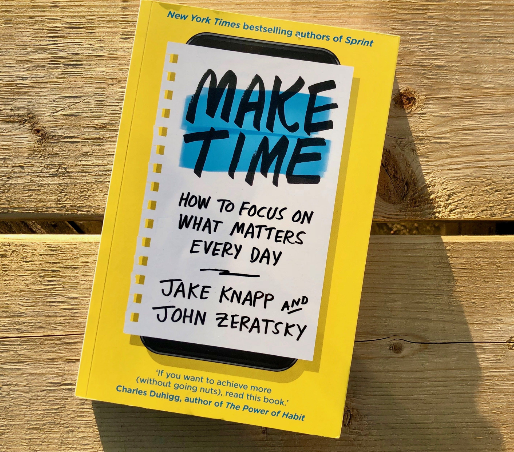
Make Time: How to Focus on What Matters Every Day
📖 Introduction: Why This Book Matters
In an era where distraction has become the default mode of existence, Make Time arrives as a field manual for reclaiming your attention. This isn’t another productivity manifesto promising you’ll conquer your to-do list or optimize every waking moment. Instead, it’s a rebellion against the very systems designed to fragment your focus—the incessant notifications, the infinity pools of social media, the cultural worship of busyness. The book matters because it reframes the conversation: productivity isn’t about doing more; it’s about making deliberate choices about what deserves your finite energy and attention.
📘 Synopsis
Make Time presents a practical four-step daily framework designed to help you escape the default settings of modern life. The authors argue that we’ve surrendered our time to two powerful forces: the Busy Bandwagon (endless productivity theater) and Infinity Pools (apps and services engineered to consume unlimited attention). Rather than offering a rigid system, Knapp and Zeratsky provide 87 tactics organized around their four-step framework, encouraging readers to experiment and customize based on what actually works for their lives. The book is refreshingly anti-dogmatic, acknowledging that different strategies work for different people at different times.
🔍 The Author’s Journey
Jake Knapp and John Zeratsky aren’t productivity gurus preaching from ivory towers—they’re reformed tech insiders who helped create the very distraction machines they now critique. Knapp spent a decade at Google, where he developed the Design Sprint methodology used by teams worldwide. Zeratsky was a design partner at Google Ventures, working with startups on everything from Slack to Uber. Their credibility stems from intimate knowledge of how technology companies deliberately engineer products to capture and hold attention.
What makes their perspective invaluable is their insider-turned-skeptic stance. They’ve witnessed firsthand the sophisticated psychological tactics deployed to keep users scrolling, clicking, and checking. Their journey from Silicon Valley designers to attention advocates gives the book an authenticity that purely academic or theoretical approaches lack. They’re not anti-technology zealots; they’re pragmatists who understand both the value and the cost of our digital tools.
👥 Who Should Read This / Who This Book Is For
This book speaks directly to anyone who ends the day wondering where their time disappeared. If you’ve ever felt like you’re drowning in commitments yet accomplishing nothing meaningful, this is for you. It’s ideal for knowledge workers trapped in meeting marathons, creative professionals struggling to protect deep work time, parents trying to be present with their families, and anyone who’s exhausted from perpetual digital connectivity.
The sweet spot audience includes people who’ve tried traditional productivity systems and found them either too rigid or oddly amplifying their stress. It’s particularly valuable for self-aware tech users who recognize they’re being manipulated but haven’t found practical alternatives. However, it’s less suitable for those seeking detailed time management techniques for complex projects or corporate executives needing systematic organizational transformation strategies.
🔑 Key Model/Framework from the Book
The Make Time Framework consists of four daily steps that create a sustainable rhythm:
1. HIGHLIGHT – Each day, choose one priority that deserves your focused attention. Not three, not five—one anchor activity that would make the day feel successful. This could be a 60-minute block or an all-day project, but it becomes your gravitational center.
2. LASER – Redesign your environment and habits to protect focus. This means defeating distraction before it arrives: removing temptations, creating barriers to interruption, and building systems that default to deep work rather than fragmented attention.
3. ENERGIZE – Optimize your physical state through movement, nutrition, sleep, and recovery. The authors recognize that attention is biological—you can’t laser-focus when you’re exhausted, undernourished, or sedentary.
4. REFLECT – Close each day by evaluating what worked. Which tactics helped you make time for your Highlight? What drained your energy? This builds a personalized playbook over time.
The genius of this framework is its cyclical nature—each day is both a standalone experiment and part of a longer learning curve. You’re not failing if tactics don’t work; you’re gathering data.
📊 By the Numbers
The book draws on research and observations about modern attention:
- Smartphone checks: Average users check their phones 96 times per day, roughly once every 10 minutes during waking hours
- Infinity Pool consumption: People spend approximately 4+ hours daily on smartphones, much of it in apps designed for endless scrolling
- Meeting proliferation: Since 2000, time spent in meetings has increased by 50% or more for many knowledge workers
- Context switching cost: Research suggests it takes an average of 23 minutes to fully return to a task after an interruption
- Default calendar syndrome: When time isn’t explicitly allocated, reactive tasks and other people’s priorities automatically fill it
- Email volume: The average professional receives 120+ emails per day, creating constant low-grade cognitive load
These numbers underscore the authors’ central argument: without deliberate intervention, your time will be consumed by systems optimized for everyone’s agenda except yours.
💡 Key Takeaways & Counterintuitive Insights
The Highlight Principle: Choosing one focal point daily sounds limiting, but it’s liberating. You’re not abandoning other responsibilities—you’re acknowledging that everything can’t be equally important. This single decision creates clarity in an otherwise chaotic day.
Distraction is a Design Choice: You’re not weak-willed; you’re up against billion-dollar companies employing PhDs in persuasive technology. Recognizing this shifts the burden from personal failure to environmental design.
Busy and Productive Are Opposites: Being in perpetual motion feels productive but often signals you’re being reactive rather than proactive. True productivity might look like doing fewer things with greater intention.
Energy Management Trumps Time Management: All the productivity hacks in the world won’t help if you’re exhausted. Sleep, exercise, and nutrition aren’t optional extras—they’re the foundation of attention.
Your Phone’s Default Settings Are Not Neutral: Every notification, app placement, and interface choice is designed to maximize engagement. Treating your devices as neutral tools is naive; they require active reconfiguration.
Saying No is Saying Yes: Every commitment you decline creates space for your Highlight. The opportunity cost of saying yes indiscriminately is astronomical.
Tactics Over Systems: The book rejects one-size-fits-all productivity systems. What works for you might not work for your colleague, and what works today might not work next month. Experimentation is the system.
🧠 Myth-Busting Moments
Myth: You need to check email constantly to be responsive
Reality: Most emails aren’t urgent, and delayed responses rarely create real problems. Batching email into specific time blocks improves both quality of response and peace of mind.
Myth: Multitasking is an efficient use of time
Reality: Human brains don’t actually multitask—they rapidly switch between tasks, with significant cognitive cost. Single-tasking, even if it feels slower, produces better work faster.
Myth: Staying connected keeps you informed
Reality: Constant news consumption creates anxiety without meaningful knowledge gains. Strategic disconnection doesn’t make you ignorant; it makes you selective.
Myth: More hours equals more output
Reality: Exhaustion destroys the quality of thinking. Working fewer hours with better energy often produces superior results.
Myth: Technology is neutral
Reality: Every app, platform, and device embeds values and incentives. The assumption of neutrality is precisely what allows technology to shape behavior unconsciously.
Myth: You’ll find time eventually
Reality: Time doesn’t reveal itself; you must actively create it by saying no, building barriers, and designing your environment deliberately.
💬 Best Quotes from the Book
The authors offer memorable insights throughout, though I’ll paraphrase the core wisdom rather than reproduce exact lengthy passages:
- On the futility of fighting willpower battles daily against engineered distraction
- On how becoming unreachable is increasingly a competitive advantage
- On the idea that being present for one moment fully beats being half-present for many
- On treating every day as an experiment rather than a test to pass or fail
- On the recognition that defaults determine destiny more than decisions do
- On how saying yes to everything means saying yes to nothing that matters
🚀 Actionable Steps: How to Apply It Today
Start with Highlight Selection: Tomorrow morning, before checking email or social media, write down your one Highlight. Ask yourself: What’s the single activity that would make tomorrow feel successful? Choose something that takes 60-90 minutes.
Audit Your Infinity Pools: Identify which apps on your phone are designed for endless scrolling. Social media, news, streaming services, and games typically qualify. Remove them from your home screen or delete them entirely for a week-long experiment.
Create a Distraction-Free Phone: Turn off all non-essential notifications. Enable grayscale mode to make your phone visually boring. Log out of social media apps so accessing them requires intentional effort.
Design Your Environment: Remove visible distractions from your workspace. Put your phone in another room during focus blocks. Use website blockers during your Highlight time.
Establish Email Boundaries: Batch email checking into two or three specific times daily rather than leaving it open continuously. Set expectations with colleagues about response times.
Schedule Your Highlight: Actually block time on your calendar for your daily Highlight. Treat it as sacred as you would a meeting with your most important client.
Optimize Your Biology: Go to bed 30 minutes earlier. Take a short walk after lunch. Experiment with caffeine timing to avoid afternoon crashes.
Build a Reflect Ritual: Before bed, spend five minutes noting what worked today. Which tactics helped you make time? Which drained energy? Adjust tomorrow accordingly.
⚡ First 24 Hours Action Plan
Hour 1: Read the book’s introduction and framework overview to understand the four-step approach.
Hour 2: Conduct your personal technology audit—list every app on your phone and every website you visit reflexively. Circle the Infinity Pools.
Hour 3-4: Configure your phone for focus. Delete or hide social media apps, turn off notifications except for actual humans (texts, calls), enable grayscale, and remove email from your phone if possible.
Hour 5: Choose tomorrow’s Highlight. Write it down. Block 60-90 minutes on your calendar to protect it.
Evening: Prepare your environment. Charge your phone outside the bedroom. Set out workout clothes if morning exercise is part of your Energize strategy. Prepare a simple breakfast.
Next Morning: Execute your Highlight before checking email or news. Notice what distractions still emerge and note them for tomorrow’s design improvements.
End of Day 1: Complete your first Reflect session. What made today different? What still needs adjustment?
🎯 3-Minute Challenge
Right now, take out your phone. Go to Settings. Turn on grayscale mode (iOS: Settings → Accessibility → Display & Text Size → Color Filters; Android: Settings → Accessibility → Visibility enhancements → Color adjustment). Your phone will instantly become less alluring, less dopamine-triggering, and less likely to pull you into mindless scrolling. Notice how much less appealing those colorful app icons become when they’re rendered in shades of gray.
Your prompt: Live with a grayscale phone for the next 72 hours and observe how your relationship with your device changes.
🧑💼 How Real People Used It
The framework’s flexibility allows for diverse applications. One software developer used the Highlight principle to protect two hours each morning for deep coding work, transforming his productivity by accomplishing in focused morning sessions what previously took scattered full days.
A marketing executive applied the Infinity Pool tactics by deleting social media from her phone entirely, discovering she didn’t actually miss it—she missed the illusion of connection it provided. Her Reflect practice revealed most social media time was anxious procrastination rather than genuine engagement.
A graduate student combined the Energize and Laser elements by establishing a morning routine: 20-minute walk, simple breakfast, then directly into thesis writing before opening email. This sequence became protective armor against the day’s reactive demands.
Parents have adapted the framework by making family dinner the daily Highlight, protecting it from work intrusion by establishing hard stop times and leaving phones in another room.
🤔 Skeptic’s Corner
Limited Applicability to Certain Professions: Some jobs genuinely require constant availability. Emergency room physicians, crisis counselors, and on-call IT professionals may find the advice to disconnect impractical or even unethical.
Privilege Assumptions: The freedom to design your day, delete apps, and decline meetings assumes a level of workplace autonomy many people lack. Hourly workers with surveillance software, service employees, and those in rigid hierarchies may find the tactics aspirational but unattainable.
Tech Industry Bias: The authors’ Silicon Valley background shows. The book assumes high-control knowledge work and may not translate well to manufacturing, retail, healthcare, or other sectors with different constraints.
Oversimplification of Complexity: Some projects genuinely require juggling multiple priorities simultaneously. The “one Highlight per day” approach might feel reductive when managing complex initiatives with interdependent moving parts.
Sustainability Questions: The book is light on addressing what happens when external pressures push back against your boundaries. How do you maintain these practices when facing aggressive deadlines, organizational dysfunction, or toxic workplace cultures?
Missing Depth on Systemic Issues: While the authors acknowledge technology companies engineer distraction, they focus on individual solutions rather than advocating for regulatory changes or collective action against exploitative design practices.
🔄 Before & After Reading
BEFORE READING:
- Days feel reactive and fragmented
- Guilt about phone usage but no clear alternative
- Productivity defined by busyness and task completion
- Energy crashes treated as personal failures
- Technology relationships feel involuntary
- Saying yes to everything seems necessary
- Time disappears into mysterious black holes
AFTER READING:
- Days organized around intentional priorities
- Specific tactics for reconfiguring technology relationships
- Productivity redefined as meaningful progress on what matters
- Energy recognized as manageable through deliberate habits
- Technology treated as tools requiring active design choices
- Boundaries understood as prerequisites for focus
- Time becomes visible and designable
The transformation isn’t about perfection—it’s about agency. You move from feeling victimized by modern life’s demands to recognizing you have more control than you believed.
⭐ Rating & Analysis
| Aspect | Rating | Why? |
|---|---|---|
| Usefulness | ★★★★★ | Immediately actionable tactics that produce tangible results within days. The 87 strategies ensure everyone finds applicable ideas. |
| Readability | ★★★★★ | Conversational, humorous, and structured for easy navigation. Short chapters with clear headers make it perfect for busy readers. |
| Originality | ★★★☆☆ | Synthesizes existing productivity wisdom with fresh framing. The insider tech critique adds novelty, but core concepts aren’t revolutionary. |
| Impact | ★★★★☆ | Can fundamentally shift how you structure your days and relate to technology. However, impact depends heavily on implementation commitment. |
| Practicality | ★★★★★ | Exceptional. The experimentation approach acknowledges that different tactics work for different people, avoiding dogmatic prescriptions. |
| Timelessness | ★★★★☆ | The core framework will age well, though specific technology tactics may need updating as platforms evolve. The philosophy transcends trends. |
Overall: 4.5/5 stars – A rare productivity book that respects your intelligence, acknowledges complexity, and provides genuine value without empty hype.
🎬 If This Book Were a Movie
Genre: Heist thriller meets personal drama
Protagonist: Casey, a talented designer drowning in notifications and commitments, racing toward burnout while missing life’s meaningful moments.
Antagonists: The Algorithm (personified as a smooth-talking digital entity) and The Busy Bandwagon (a relentless social pressure)
Plot Arc: Casey discovers a underground movement of attention rebels who’ve broken free from digital manipulation. With mentors Jake and John as her guides, she learns to “steal back” her time through strategic tactics, facing resistance from her workplace and social circle. The climax involves choosing between a promotion requiring 24/7 availability and protecting space for what actually matters.
Supporting Characters: The Distracted Masses (zombie-like scrollers), The Reformed Tech Executive (sympathetic reformed villain), The Family (what Casey’s fighting for)
Twist Ending: The real heist wasn’t stealing time from technology—it was discovering time was never gone, just hidden behind bad defaults.
📚 Books That Pair Well With This
Complementary reads:
- Deep Work by Cal Newport – Provides the philosophical foundation for why focused attention matters; pairs with Make Time’s tactical how-to
- Atomic Habits by James Clear – Offers habit formation strategies that support implementing Make Time’s daily framework
- Digital Minimalism by Cal Newport – Goes deeper on the philosophy of intentional technology use
- Indistractable by Nir Eyal – Written by a former insider on behavior design, offers complementary distraction-management tactics
- The Ruthless Elimination of Hurry by John Mark Comer – Explores the spiritual and philosophical dimensions of slowing down
Contrasting perspectives:
- The 4-Hour Workweek by Tim Ferriss – Represents the efficiency-maximization approach Make Time deliberately rejects
- Getting Things Done by David Allen – Traditional comprehensive productivity system; interesting to compare with Make Time’s anti-system stance
📚 Resources
From the book:
- Official Make Time website with downloadable tactics PDF and community forum
- Design Sprint methodology resources for teams interested in applying focus principles organizationally
- Time Timer visual timers recommended for Highlight time-boxing
- Freedom and SelfControl apps for website blocking during Laser mode
Related resources:
- Rescue Time for tracking actual time usage patterns
- Moment app for iPhone usage awareness
- Inbox When Ready for Gmail to remove inbox count visibility
- Forest app for gamified focus sessions
✍️ Final Reflection: Was It Worth Reading?
Absolutely. Make Time succeeds where most productivity books fail: it treats you as an intelligent adult capable of experimentation rather than a broken machine needing fixing. The four-step framework is genuinely useful without being oppressively prescriptive. After reviewing hundreds of books over my career, I recognize when authors are selling snake oil versus sharing hard-won wisdom—Knapp and Zeratsky clearly live these principles.
What elevates this book is its unusual combination of tactical specificity and philosophical humility. The authors don’t claim to have discovered universal laws of productivity. Instead, they offer a menu of experiments backed by their experience, research, and insider understanding of attention engineering. The result feels like advice from experienced friends rather than gurus on pedestals.
The book’s greatest strength is acknowledging modern life’s genuine constraints while refusing to surrender to them. It doesn’t promise you’ll magically have more hours or accomplish everything on your fantasy to-do list. It promises something better: you’ll spend your finite time on what actually matters to you, and you’ll end days feeling satisfied rather than scattered.
Is it perfect? No. The privilege assumptions and limited engagement with systemic issues are real weaknesses. But as a practical guide for individuals seeking to reclaim attention in an attention economy designed to exploit them, it’s exceptional.
Would I recommend it? Without reservation—to anyone who’s ever ended a day wondering where their time went despite being “busy” all day. Your future self, focused and present, will thank you.
💬 Your Turn
I’m curious: What’s your biggest time trap? Is it the Busy Bandwagon of endless commitments, or the Infinity Pools of digital distraction? Have you tried any tactics for reclaiming attention that actually worked?
If you implement the Make Time framework, I’d love to hear what you chose as your first Highlight and which Laser tactics made the biggest difference. The beauty of this approach is its diversity—everyone’s playbook looks different.
Drop a comment sharing your experience or the one change you’re committing to make today. Sometimes public commitment increases follow-through, and your insight might inspire someone else’s breakthrough.
What will your Highlight be tomorrow?