
Attached by Amir Levine and Rachel Heller
 wkadmin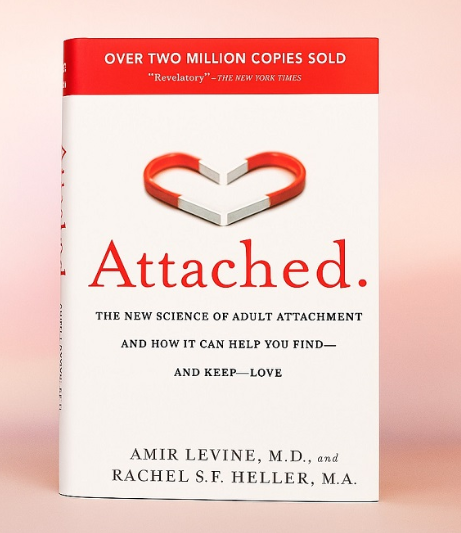
📖 Introduction: Why This Book Matters
Have you ever wondered why some relationships feel effortless while others become exhausting emotional battlegrounds? This book revolutionizes how we understand romantic connections by revealing that our attachment styles—invisible blueprints formed in childhood—are secretly orchestrating our love lives. Rather than blaming “commitment issues” or “neediness,” Levine and Heller offer a scientific framework that transforms relationship struggles from mysterious failures into predictable patterns we can actually change.
📘 Synopsis
This groundbreaking work translates decades of psychological research into a practical guide for modern romance. The authors introduce attachment theory as a lens for understanding why we behave the way we do in relationships—why some people crave closeness while others flee from it, and why certain pairings create fireworks while others fizzle into frustration. The book dismantles the myth that independence and emotional distance signal relationship maturity, arguing instead that our fundamental need for connection is both biological and healthy. Through real-world examples and scientific evidence, it empowers readers to identify their attachment patterns and make conscious choices that lead to more fulfilling partnerships.
🔍 The Author’s Journey
Amir Levine is a psychiatrist and neuroscientist whose clinical work revealed patterns that traditional relationship advice couldn’t explain. His patients weren’t struggling because they were “too needy” or “damaged”—they were experiencing predictable responses based on their attachment wiring. This observation led him to dive deep into attachment research, translating complex neuroscience into accessible wisdom.
Rachel Heller brought her expertise in social-organizational psychology and years of experience helping individuals navigate relationship challenges. Together, they recognized a gap in popular psychology: while attachment theory was well-established in academic circles, it remained frustratingly inaccessible to the people who needed it most—those caught in painful relationship cycles they couldn’t understand or break.
👥 Who Should Read This / Who This Book Is For
Perfect for:
- Anyone who feels confused by their own behavior in relationships—the person who pulls away when things get serious, or who becomes anxious when their partner needs space
- People stuck in painful relationship patterns, wondering why they keep attracting the wrong partners or sabotaging good connections
- Those who’ve been told they’re “too needy” or “afraid of commitment” and suspect there’s more to the story
- Therapists, counselors, and coaches seeking a practical framework for helping clients with relationship issues
- Anyone starting a new relationship who wants to build it on a foundation of self-awareness rather than trial and error
Not ideal for:
- Readers seeking quick fixes or manipulation tactics
- Those looking for gender-specific dating strategies rather than universal psychological principles
🔑 Key Model/Framework from the Book
The Three Attachment Styles:
The book centers on a deceptively simple but profound framework dividing adults into three attachment categories:
Secure (approximately 50% of the population): These individuals are comfortable with intimacy and independence. They communicate needs directly, don’t play games, and can both give and receive support naturally. They view relationships as partnerships rather than battlegrounds.
Anxious (approximately 20%): These people crave closeness and worry about their partner’s availability. They’re highly sensitive to relationship threats, often need reassurance, and can become preoccupied with their relationships. Their internal alarm system for connection runs hot.
Avoidant (approximately 25%): These individuals prize independence and self-sufficiency, often feeling overwhelmed by too much closeness. They value freedom, may idealize being single, and can struggle to recognize their own need for connection. Their alarm system for intimacy triggers withdrawal.
The framework’s power lies not just in categorizing people but in explaining the chemistry between styles—why anxious-avoidant pairings create such dramatic push-pull dynamics, and why secure individuals can help partners become more secure themselves.
📊 By the Numbers
- Research spanning over 50 years supports attachment theory across cultures and contexts
- Approximately 50% of adults have a secure attachment style
- About 20-25% are anxious, and 20-25% are avoidant (with some falling into mixed or disorganized categories)
- Studies show attachment styles remain relatively stable across adulthood, though they can shift with significant relationship experiences
- Secure individuals report higher relationship satisfaction, and their relationships last longer on average
- The “protest behaviors” of anxious attachment (calling excessively, picking fights, threatening to leave) activate in response to perceived threats to connection
- Brain imaging studies reveal that thoughts of separation activate the same neural regions as physical pain in anxiously attached individuals
💡 Key Takeaways & Counterintuitive Insights
The Dependency Paradox: Our culture celebrates independence, but the book reveals that the most independent, resilient people are those who feel securely connected to others. Knowing someone has your back actually makes you braver, not weaker.
“Playing it cool” backfires: The dating advice to remain aloof and mysterious actually sabotages relationship formation. Secure people express interest openly and don’t engage in strategic distancing.
Anxious isn’t the same as insecure: Anxiously attached people aren’t lacking confidence across the board—they’re specifically sensitive to connection threats. They might be CEOs or accomplished artists while still struggling with relationship anxiety.
Your picker isn’t broken: If you consistently choose avoidant partners despite wanting closeness, it’s not because you unconsciously self-sabotage. Avoidant people often present as attractive initially—confident, independent, intriguing—but their style becomes problematic only over time.
Chemistry can mislead: That electric, can’t-stop-thinking-about-them feeling might signal compatibility—or it might signal you’ve found someone whose unavailability triggers your attachment system into overdrive.
Not all relationship advice applies to you: Guidance to “give them space” helps secure couples but can torture anxious individuals partnered with avoidants. Attachment-aware strategies work better.
🧠 Myth-Busting Moments
MYTH: Needing reassurance means you’re insecure and damaged.
REALITY: All humans have attachment needs. Secure people get them met efficiently; anxious people struggle when partners are inconsistent.
MYTH: Successful relationships require two completely independent people.
REALITY: Healthy interdependence—mutual reliance—predicts relationship success better than independence does.
MYTH: If you’re anxious, you need to work on yourself before you can have a healthy relationship.
REALITY: Anxiously attached people often become more secure with a responsive partner. The relationship itself can be healing.
MYTH: Playing hard to get attracts quality partners.
REALITY: This strategy primarily attracts avoidant individuals and repels secure ones, who prefer clear communication.
MYTH: Attachment styles are permanent personality traits.
REALITY: While relatively stable, attachment styles can shift based on relationship experiences, particularly with secure partners.
MYTH: Avoidant people don’t want relationships.
REALITY: They desire connection but manage anxiety about intimacy through distance. Their needs manifest differently, not absent.
💬 Best Quotes from the Book
Note: These are paraphrased concepts from the book, not direct quotations:
- The essence of relationships isn’t about finding someone who never triggers your insecurities, but finding someone who responds well when they do.
- Your attachment system exists to keep you connected—when it sounds alarms, it’s doing its job, not revealing your weakness.
- The question isn’t whether you have attachment needs, but whether your partner is responsive to them.
- Effective communication in relationships means clearly expressing what you need, not hoping your partner will guess.
- If you’re constantly anxious in your relationship, the problem might not be your anxiety—it might be that you’re with someone who can’t consistently meet your legitimate needs for connection.
- Secure people don’t play games because they don’t need to—they trust that honest expression of interest and needs will work out better in the long run.
🚀 Actionable Steps: How to Apply It Today
1. Identify Your Attachment Style
Take stock of your patterns across relationships. Do you worry about abandonment? Do you feel suffocated by closeness? Or do you generally feel comfortable with both intimacy and independence?
2. Recognize Your Triggers
Map what activates your attachment system—unanswered texts, cancelled plans, talk of future commitment. Understanding your triggers helps you distinguish real threats from false alarms.
3. Communicate Attachment Needs Directly
Instead of protesting or withdrawing, practice stating needs clearly: “I feel more secure when we check in during the day” or “I need some alone time to recharge.”
4. Evaluate Partner Compatibility Through an Attachment Lens
Don’t just ask “Do I like them?” Ask: “Does this person respond to my needs? Do our attachment styles create ease or constant friction?”
5. Practice Effective Communication
Use the principles outlined in the book: be specific, avoid blame, express needs in terms of positive actions your partner can take.
6. For Anxious Types: Fact-Check Your Worries
When anxiety spikes, distinguish between actual partner behavior and worst-case scenarios your mind generates.
7. For Avoidant Types: Challenge Your Independence Narrative
Notice when you frame connection as obligation or when you idealize being alone. Experiment with letting people in.
8. For All: Seek Secure Partners
If you’re anxious or avoidant, prioritize dating secure individuals who can help regulate your attachment system rather than inflame it.
⚡ First 24 Hours Action Plan
Hour 1: Write down your last three significant relationships and identify patterns in how they began, unfolded, and ended. What role did anxiety about connection or discomfort with closeness play?
Hour 2-3: Take the informal attachment style assessment from the book or a research-validated one online. Read about your style with curiosity, not judgment.
Hour 4-6: If currently in a relationship, have a conversation with your partner about attachment styles. Share your style and ask about theirs. Discuss how this framework explains past conflicts.
Hour 12: Identify one specific attachment-related behavior you want to change. For example: “When I feel anxious, I’ll express it directly rather than picking fights.”
Hour 24: If single, revise your approach to dating with attachment in mind. If partnered, implement one small change in how you communicate a need. Notice the response.
🎯 3-Minute Challenge
Right now, grab your phone and do this:
Think of one recurring relationship frustration—something that happens again and again. Write it down. Now reframe it through attachment theory: Is this an anxious protest behavior? An avoidant deactivating strategy? A mismatch between your attachment needs and your partner’s style?
Share your realization with one trusted person today. Text them: “I just learned something about why I do [behavior] in relationships, and it’s not what I thought.”
Why this matters: Naming the pattern begins changing it. Speaking it aloud creates accountability and often reveals you’re not alone in your struggles.
🧑💼 How Real People Used It
Sarah, 34, Marketing Director:
After years of intense, dramatic relationships, Sarah realized she had an anxious attachment style that was attracted to avoidant men who seemed “mysterious.” Armed with this knowledge, she started dating differently—choosing responsiveness over excitement. Within a year, she met someone secure who seemed “boring” initially but proved consistently caring. She’s now engaged and reports feeling calmer than ever before.
Michael, 41, Entrepreneur:
Michael’s string of failed relationships made sense once he recognized his avoidant patterns. He’d been framing his need for space as “healthy boundaries” while actually distancing whenever intimacy deepened. Using the book’s strategies, he learned to communicate his need for independence without disappearing, and to recognize when his partner’s desire for closeness was reasonable rather than “clingy.”
The Couple Who Saved Their Marriage:
One couple on the brink of divorce discovered they were in the classic anxious-avoidant trap. She pursued, he withdrew, she pursued harder, he withdrew further. Understanding this dance allowed them to interrupt it—she learned to express needs calmly rather than through protest, and he learned that meeting her needs for reassurance actually gave him more freedom, not less.
🤔 Skeptic’s Corner
Potential Weaknesses:
Oversimplification Risk: Three categories can’t capture every human’s complexity. Some people display mixed or context-dependent attachment patterns that resist neat categorization.
Limited Cultural Perspective: Much of the research underlying attachment theory comes from Western, individualistic cultures. How attachment manifests in collectivist societies may differ.
The “Fixed” Mindset Trap: While the book emphasizes that styles can change, some readers might use their attachment label as an excuse rather than a starting point for growth.
Partner Selection Emphasis: The strong message to leave incompatible partners might not account for relationships where both people are willing to do significant work, or for practical constraints that make leaving difficult.
The Avoidant Paradox: The book may not fully address that many avoidant individuals are content with their style and don’t experience it as problematic, raising questions about whether “fixing” it is always necessary.
Research Evolution: Some of the specific statistics and studies mentioned have been refined or challenged by more recent research, though the core framework remains solid.
🔄 Before & After Reading
BEFORE:
- Believing your relationship struggles stem from personal deficiency or bad luck
- Thinking you’re “too needy” or your partner is “commitment-phobic” without understanding why
- Using trial-and-error dating strategies based on popular advice that contradicts your instincts
- Feeling confused about why certain relationships feel easy while others feel like constant work
- Assuming your strong reactions to relationship events mean you’re irrational or damaged
AFTER:
- Recognizing your behavior patterns as predictable responses from an identifiable attachment style
- Understanding that needing connection is biologically normal, not a weakness to overcome
- Making conscious partner choices based on attachment compatibility, not just attraction
- Seeing relationship dynamics as dances between two attachment systems rather than individual failures
- Communicating needs directly instead of through protest behaviors or withdrawal
- Choosing relationships that calm your nervous system rather than constantly activate it
⭐ Rating & Analysis
| Aspect | Rating | Why? |
|---|---|---|
| Usefulness | ★★★★★ | Transforms abstract psychology into immediately applicable relationship wisdom |
| Readability | ★★★★☆ | Accessible and engaging, though some concepts require rereading to fully grasp |
| Originality | ★★★★☆ | Adapts existing research for popular audience brilliantly; framework itself isn’t new but application is fresh |
| Impact | ★★★★★ | Genuinely life-changing for many readers; shifts fundamental relationship paradigms |
| Practicality | ★★★★☆ | Highly actionable strategies, though implementing them requires partner cooperation and personal courage |
| Timelessness | ★★★★★ | Based on decades of research into fundamental human nature; won’t become outdated |
🎬 If This Book Were a Movie
Genre: Psychological drama with romantic comedy elements
Protagonist: Alex (composite character), a successful but perpetually single professional who believes they’re “just not meant for relationships”
Plot Arc: Alex discovers attachment theory after another relationship implodes mysteriously. As they investigate their own patterns, they realize they’ve been unconsciously choosing unavailable partners who confirm their anxious attachment beliefs. The journey involves confronting childhood experiences, learning to recognize secure partners (who initially seem “boring”), and ultimately choosing connection over familiar painful patterns.
Supporting Characters:
- The Avoidant Ex: Charming, successful, but ultimately unable to provide emotional consistency—represents the “spark” that actually signals incompatibility
- The Secure Friend: Has been modeling healthy relationships all along, but Alex dismissed their advice as not applicable to “complex” people like themselves
- The Therapist: Introduces attachment theory at the crisis point, serving as guide through self-discovery
Climactic Scene: Alex must choose between returning to the exciting but emotionally unavailable ex or building something steady with a secure new person who genuinely sees and values them.
Resolution: Alex learns that the butterflies they associated with “true love” were actually anxiety, and real connection feels like coming home.
📚 Books That Pair Well With This
Complementary Reads:
- Hold Me Tight by Dr. Sue Johnson (Expands on creating secure bonds in existing relationships)
- Wired for Love by Stan Tatkin (Neuroscience perspective on attachment in couples)
- The Body Keeps the Score by Bessel van der Kolk (Understanding how early attachment trauma affects us physiologically)
Contrasting Perspectives:
- Mating in Captivity by Esther Perel (Explores the tension between security and desire, offering a different lens on relationship needs)
- Modern Romance by Aziz Ansari (Sociological view of dating in the digital age that complements the psychological approach)
Deeper Dives:
- Becoming Attached by Robert Karen (Academic exploration of attachment theory’s history and research)
- A General Theory of Love by Lewis, Amini, and Lannon (Neuroscience of love and connection)
📚 Resources
Assessment Tools:
- The Experiences in Close Relationships (ECR) questionnaire (research-validated assessment available online)
- The book includes informal self-assessment questions throughout
Further Learning:
- The Center for Attachment Research at The New School
- Dr. Amir Levine’s website and occasional public talks
- Adult Attachment Interview (professional assessment tool)
Therapeutic Approaches:
- Emotionally Focused Therapy (EFT) – directly based on attachment theory
- PACT (Psychobiological Approach to Couple Therapy) – incorporates attachment science with neuroscience
Online Communities:
- Various attachment theory forums and subreddits where people discuss applying these concepts (approach with discernment, as informal advice varies in quality)
✍️ Final Reflection: Was It Worth Reading?
Absolutely, and here’s why:
This book belongs in that rare category of psychology works that genuinely changes how you see yourself and your relationships. Unlike much relationship advice that offers surface-level tips, Attached provides a lens through which seemingly mysterious behaviors suddenly make complete sense.
The genius lies in the book’s refusal to pathologize normal attachment needs. Instead of telling anxious people to “work on themselves” until they need less, or avoidant people to “open up” through sheer willpower, it acknowledges that these patterns served protective purposes once—and that they can shift with awareness and the right relational environment.
What makes this essential reading is its dual power: it offers both explanation and permission. Permission to need connection without shame. Permission to leave relationships that constantly activate your attachment system’s alarm bells. Permission to believe that your relationship struggles might not be character flaws but compatibility issues.
The book doesn’t promise that understanding your attachment style will magically fix everything—relationships still require effort, communication, and sometimes difficult choices. But it replaces confusion with clarity, self-blame with self-understanding, and aimless pattern repetition with intentional growth.
If you’ve ever felt crazy in a relationship, wondered why you sabotage good things, or questioned whether you’re “too much” or “too distant,” this book offers answers that feel both scientifically sound and deeply validating. It’s the relationship manual many of us wish we’d received before our first heartbreak.
Worth reading? Not just worth it—potentially life-changing. This is knowledge that compounds over time, influencing not just current relationships but how you approach every connection moving forward.
💬 Your Turn
Now that you’ve explored the world of attachment theory, here’s my question for you:
What relationship pattern have you repeated that finally makes sense through an attachment lens?
Have you been unconsciously choosing partners who confirm your deepest fears? Does understanding your attachment style change how you view past relationship “failures”? Are you currently in a relationship where recognizing the attachment dance could transform your dynamic?
I’d love to hear:
- Your attachment style and biggest “aha” moment from learning about it
- A relationship that would have gone differently if you’d known this framework
- How you’re applying attachment theory to your current relationships (or dating approach)
- Whether you’re skeptical about any aspects of the model
Drop your thoughts, experiences, or questions in the comments. Let’s create a space where we can explore these patterns together—because understanding attachment theory is even more powerful when we share our stories and learn from each other’s journeys.
Your relationship patterns aren’t random, and you’re not alone in them. Let’s talk about it.