
The 5 AM Club by Robin Sharma
 wkadmin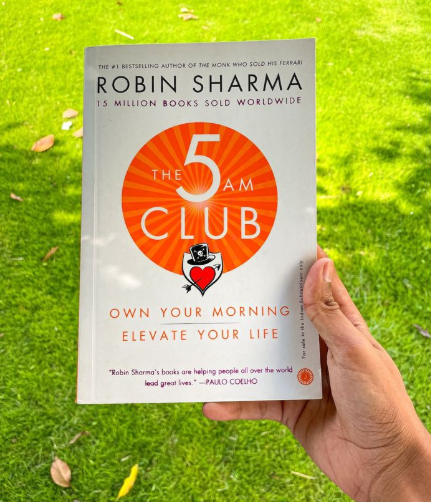
📖 Introduction: Why This Book Matters
In a world drowning in distractions and endless demands, this book presents a radical proposition: the first hour of your day determines the quality of your entire life. Sharma challenges the modern narrative that success requires constant connectivity and reactive living. Instead, he argues that true mastery—personal, professional, and spiritual—begins in the quiet solitude of dawn, before the world wakes and chaos intrudes. This matters because most people surrender their mornings to notifications, emails, and other people’s agendas, effectively giving away their most productive hours. The book reframes early rising not as deprivation but as an act of self-respect and intentional living.
📘 Synopsis
The book follows a fictional narrative featuring an entrepreneur, an artist, and an eccentric billionaire who teaches them the transformative power of waking at 5 AM. Through this story, Sharma weaves practical strategies, neuroscience research, and philosophical wisdom about peak performance. The central argument is straightforward: dedicating the first hour of your day to personal growth—through exercise, reflection, and learning—creates compound advantages that cascade throughout your life. The book outlines specific routines, explains the science behind habit formation, and provides a blueprint for becoming what Sharma calls a “world-builder” rather than a “world-follower.”
🔍 The Author’s Journey
Robin Sharma began his career as a litigation lawyer before experiencing a personal awakening about the emptiness of conventional success. This crisis prompted him to leave law and dedicate himself to studying peak performance, leadership, and human potential. He became a globally recognized leadership expert, working with Fortune 500 companies, professional athletes, and world leaders.
His previous work, particularly around personal mastery and excellence, established him as a thought leader in the self-improvement space. Sharma’s approach blends Eastern philosophy with Western productivity science, reflecting his deep study of both wisdom traditions and modern neuroscience. His credibility stems not just from research but from decades of coaching high achievers and witnessing firsthand what separates exceptional performers from everyone else.
👥 Who Should Read This / Who This Book Is For
This book speaks directly to anyone feeling trapped in mediocrity despite having potential. It’s for professionals who’ve hit a plateau, creatives struggling to find focus, entrepreneurs building something meaningful, and anyone exhausted by the reactive hamster wheel of modern life.
Perfect readers include: ambitious individuals seeking structured self-improvement, people wanting to reclaim control of their time, those interested in habit formation and neuroscience, leaders looking to elevate their performance, and anyone curious about the intersection of productivity and well-being. It’s particularly valuable for skeptics of morning routines who need scientific backing and practical frameworks, not just motivational platitudes.
🔑 Key Model/Framework from the Book
The 20/20/20 Formula is the book’s cornerstone framework for the Victory Hour (5-6 AM):
- First 20 Minutes – Move: Intense exercise to activate neurochemicals, flush out cortisol, and trigger BDNF (brain-derived neurotrophic factor) for cognitive enhancement
- Second 20 Minutes – Reflect: Meditation, prayer, journaling, or planning to deepen self-awareness and clarify intentions
- Third 20 Minutes – Grow: Learning through reading, listening to educational content, or skill development
This structure isn’t arbitrary—each segment targets specific neurobiological and psychological needs. The formula also incorporates the concept of the “Habituation Phase,” which states that it takes 66 days to neurologically install a new behavior pattern, broken into three stages: destruction (days 1-22, characterized by discomfort), installation (days 23-44, involving integration), and consolidation (days 45-66, achieving automation).
📊 By the Numbers
- 66 days: The scientifically-backed timeline for habit installation
- 5 AM: The optimal wake time for capturing elite performance hours
- 20/20/20: The minute breakdown of the Victory Hour
- 10X: The productivity multiplier Sharma attributes to consistent early rising
- 90-minute work cycles: The book’s recommendation for deep work sessions based on ultradian rhythms
- 4 interior empires: The framework covering Mindset, Heartset, Healthset, and Soulset
The book emphasizes that willpower peaks in the morning hours and depletes throughout the day, making early personal development work exponentially more effective than evening efforts.
💡 Key Takeaways & Counterintuitive Insights
Your mornings reveal your priorities: How you start determines where you finish. Most people begin reactively; elite performers begin intentionally.
Elite performance is a skill, not a gift: Excellence isn’t innate—it’s engineered through micro-behaviors repeated consistently over time.
Isolation fuels innovation: The quietest hours offer the deepest thinking. Solitude isn’t loneliness; it’s a competitive advantage.
Discomfort precedes transformation: The resistance you feel toward change is actually evidence that you’re growing. The struggle is the pathway, not the obstacle.
Your environment shapes your identity: Small cues in your physical space trigger automatic behaviors. Design your surroundings to support your goals.
Transient hypofrontality enables breakthroughs: During intense morning exercise, the prefrontal cortex temporarily quiets, allowing creative insights to emerge from the subconscious.
The Twin Cycle of Elite Performance: Oscillation between intense work and deep recovery creates sustainable excellence, not constant grinding.
🧠 Myth-Busting Moments
Myth: “I’m not a morning person—it’s genetic.”
Reality: Sleep chronotypes have some biological basis, but they’re far more malleable than believed. Consistency in sleep and wake times rewires circadian rhythms within weeks.
Myth: “Successful people sacrifice sleep to get ahead.”
Reality: The book emphasizes that waking at 5 AM requires going to bed earlier, not sleeping less. Quality sleep is non-negotiable for peak performance.
Myth: “More hours working equals more results.”
Reality: Elite performers work in focused sprints with strategic recovery. The quality of attention matters infinitely more than the quantity of hours.
Myth: “Willpower is unlimited if you’re motivated enough.”
Reality: Willpower depletes throughout the day like a muscle. Morning hours offer maximum self-control reserves.
Myth: “Balance means giving equal time to everything.”
Reality: True balance involves deliberate imbalance—seasons of intense focus on specific priorities rather than perpetual mediocrity across all areas.
💬 Best Quotes from the Book
The book contains numerous memorable insights about personal mastery, though I’ll share the themes and wisdom rather than extensive word-for-word quotes:
- On the power of dawn as a sacred time for self-construction
- About how ordinary people can achieve extraordinary results through daily disciplines
- Regarding the compound effect of small improvements over decades
- On viewing yourself as a masterpiece in progress rather than a finished product
- About treating your talents as responsibilities rather than entitlements
🚀 Actionable Steps: How to Apply It Today
Phase 1: Preparation (Before You Start)
- Calculate your ideal bedtime by counting back 7-8 hours from 5 AM
- Remove all screens from your bedroom
- Prepare your workout clothes the night before
- Set multiple alarms across the room, forcing physical movement to turn them off
- Identify your reflection practice (journaling, meditation, prayer)
- Choose your learning material (book, course, podcast)
Phase 2: The 66-Day Installation
- Commit publicly to someone who’ll hold you accountable
- Track each morning with a visual calendar—mark every successful day
- Expect days 1-22 to feel terrible—this is neurological resistance, not failure
- Use implementation intentions: “When I hear my alarm, I will immediately sit up and place my feet on the floor”
- Build a morning sanctuary—a specific space associated only with your Victory Hour
- Protect your evening routine as fiercely as your morning one
Phase 3: Optimization
- Experiment with your 20/20/20 activities until you find your ideal combination
- Integrate the Twin Cycle: 90 minutes of focused work followed by genuine breaks
- Create environmental triggers that automate behavior (coffee station by your journal, yoga mat already rolled out)
- Schedule your most important work immediately after your Victory Hour while mental clarity peaks
⚡ First 24 Hours Action Plan
Hour 1: Set your alarm for 5 AM tomorrow. Right now. Not “starting Monday”—starting tomorrow.
Hour 2-3: Clear your evening schedule. Identify exactly what time you’ll begin your pre-sleep routine to ensure 7-8 hours of rest.
Hour 4: Prepare your physical space. Lay out workout clothes. Place your journal and learning materials where you’ll do your reflection and growth segments. Remove all barriers to execution.
Hour 6-8: Create your accountability mechanism. Text a friend your commitment. Download a habit-tracking app. Put money at stake with a commitment device if needed.
Hour 12: Protect tonight. Cancel anything that would keep you up past your target bedtime. Your first Victory Hour begins with tonight’s discipline.
Hour 24: Execute your first 5 AM wake-up. Don’t aim for perfection—aim for completion. Just do the 20/20/20, however imperfectly.
🎯 3-Minute Challenge
Right now, without overthinking, complete this challenge:
- Minute 1: Open your phone’s calendar and block 5:00-6:00 AM for the next 7 days. Title it “Victory Hour—Non-Negotiable.”
- Minute 2: Text one person: “I’m committing to waking at 5 AM for the next week to invest in my growth. Can you check in with me each morning?” Send it now.
- Minute 3: Calculate your bedtime (8 hours before 5 AM = 9 PM). Set a phone reminder for 8:30 PM titled “Begin shutdown routine—Victory Hour tomorrow depends on tonight.”
Now answer this: What’s the one project, skill, or goal that will finally move forward when you gift yourself that first sacred hour each day? Write it down.
🧑💼 How Real People Used It
While the book uses fictional characters to illustrate principles, the methodology reflects patterns observed across high achievers:
A technology executive implemented the Victory Hour during a career transition, using the morning time to build coding skills that landed her a role at a major platform company. The consistency of daily practice over six months accomplished what years of “when I have time” learning never did.
An artist struggling with creative blocks restructured her entire life around protecting 5-6 AM for her craft. Within a year, she completed a body of work that led to her first gallery exhibition. The transformation wasn’t about talent—it was about consistent access to her clearest, most focused mental state.
A burned-out entrepreneur used the framework to rebuild his health while growing his business. The morning exercise segment became non-negotiable, and the planning time allowed strategic thinking that replaced reactive firefighting. His business grew while his stress decreased—the opposite of his previous pattern.
🤔 Skeptic’s Corner
The fictional narrative feels forced: Some readers find the storyline distracting or unnecessarily dramatic. The core principles could be delivered more concisely without the extended allegory.
Cultural and privilege assumptions: The framework assumes significant control over one’s schedule, which isn’t accessible to shift workers, new parents, or people with caregiving responsibilities. Waking at 5 AM is a luxury not everyone can afford.
Oversimplification of complex issues: While morning routines help, the book sometimes overstates their impact. Deep systemic problems—financial stress, toxic work environments, health conditions—won’t be solved solely by waking early.
The 66-day timeline varies: Habit formation research shows wide individual variation. Some habits install faster, others slower. The rigid timeframe may discourage people whose brains work differently.
Productivity worship: The framework can feed into toxic hustle culture if misapplied. Rest, spontaneity, and “unproductive” time have value that the book doesn’t fully acknowledge.
Limited consideration of neurodiversity: People with ADHD, depression, or other conditions may find the prescribed routine incompatible with their neurological reality.
🔄 Before & After Reading
Before Reading – Typical Patterns:
- Mornings feel reactive and rushed
- The snooze button is your enemy and companion
- Evenings squander time on low-value activities
- Personal goals perpetually sit on “someday” lists
- Energy feels depleted by mid-afternoon
- Success feels mysterious and reserved for others
- Habits form accidentally rather than intentionally
After Reading – Transformed Approach:
- Mornings become sacred investment time
- Waking early feels like gaining an advantage, not losing sleep
- Evenings have clear purpose: preparing for tomorrow’s victory
- Personal goals receive daily, tangible progress
- Energy follows strategic management of attention and recovery
- Excellence feels like a learnable system, not innate luck
- Habits become deliberately engineered through environmental design
The deepest shift is psychological: from believing life happens to you, toward understanding you happen to life through daily choices made in the hours you protect most fiercely.
⭐ Rating & Analysis
| Aspect | Rating | Why? |
|---|---|---|
| Usefulness | ★★★★☆ | The 20/20/20 framework is immediately actionable, though not universally applicable to all life circumstances |
| Readability | ★★★☆☆ | The fable format helps some readers but frustrates others who prefer direct instruction; the narrative feels padded at times |
| Originality | ★★★☆☆ | The core concepts about morning routines and habit formation aren’t new, but Sharma’s specific framework and 66-day installation process offer fresh structure |
| Impact | ★★★★★ | For those who implement it, the transformation can be profound—it’s a complete life redesign anchored in a single daily practice |
| Practicality | ★★★★☆ | Highly practical for those with schedule flexibility; less so for shift workers, parents with young children, or those with certain health conditions |
| Timelessness | ★★★★☆ | The principles about intentional mornings and habit installation will remain relevant, though specific cultural references may date the book |
Overall Assessment: This is a powerful framework disguised as a meandering story. The core methodology works, backed by legitimate neuroscience, but requires genuine commitment and favorable life circumstances. Best approached as a philosophy to adapt rather than rules to follow rigidly.
🎬 If This Book Were a Movie
Genre: Inspirational drama with mentor-mentee elements
Protagonist: A composite character stuck between their current mediocre reality and their unrealized potential—someone we all recognize because they mirror our own internal conflicts
Plot Arc: Our hero encounters a mysterious mentor (the eccentric billionaire) who challenges everything they believe about success, time, and human potential. Through a series of dawn meetings and transformative conversations, they undergo a complete identity shift from reactive victim to intentional creator.
Supporting Characters:
- The Burnt-Out Entrepreneur: Represents the hustle-without-strategy path and its limitations
- The Blocked Artist: Embodies creative potential suffocated by distraction and doubt
- The Billionaire Mentor: Part Yoda, part Tony Robbins—unconventional wisdom wrapped in quirky personality
Climactic Moment: Not a single dramatic event but a montage of 66 consecutive dawn scenes, showing the protagonist’s gradual transformation through repetition—the cinematic representation that excellence is built in boring, daily disciplines
Resolution: The protagonist becomes the mentor to someone else, completing the cycle and demonstrating that extraordinary isn’t reserved for the chosen few—it’s available to anyone willing to master their mornings
Soundtrack: Opening with chaotic urban noise fading into serene dawn silence; building to triumphant orchestration as the routine becomes identity
📚 Books That Pair Well With This
Complementary Reads:
- Atomic Habits by James Clear: Provides deeper dive into habit formation science that supports Sharma’s 66-day framework
- Deep Work by Cal Newport: Extends the morning focus concept into protecting cognitive attention throughout your day
- The Miracle Morning by Hal Elrod: Alternative morning routine framework for comparison and customization
- Why We Sleep by Matthew Walker: Essential reading on protecting sleep quality while pursuing early rising
Contrasting Perspectives:
- Rest by Alex Soojung-Kim Pang: Argues that strategic rest and recovery matter as much as disciplined work
- Do Nothing by Celeste Headlee: Challenges productivity obsession and offers the counterargument that constant optimization can be counterproductive
- Laziness Does Not Exist by Devon Price: Explores how systems and circumstances shape behavior more than individual discipline
Related Deeper Dives:
- Peak Performance by Brad Stulberg and Steve Magness: Scientific exploration of the growth-recovery cycle Sharma references
- Flow by Mihaly Csikszentmihalyi: The psychological research behind optimal experience states accessed during the Victory Hour
📚 Resources
Concepts to Explore Further:
- BDNF (Brain-Derived Neurotrophic Factor) and neuroplasticity
- Ultradian rhythms and optimal work-rest cycles
- Transient hypofrontality and creative breakthrough states
- Implementation intentions and habit formation psychology
- Circadian rhythm manipulation and chronobiology
Practical Tools:
- Habit tracking apps (Habitica, Streaks, Productive)
- Accountability platforms (Stickk, Beeminder)
- Meditation apps for the reflection segment (Headspace, Calm, Waking Up)
- Blue light blocking glasses for evening routine
- Sleep tracking devices to optimize rest quality
Community Resources:
- Online communities of early risers for mutual support
- Local running or exercise groups for the movement segment
- Book clubs or mastermind groups meeting in morning hours
✍️ Final Reflection: Was It Worth Reading?
Honestly? It depends entirely on where you are and what you need.
If you’re someone who’s been dabbling in self-improvement without seeing real change, this book provides the structure and commitment framework you’ve been missing. The 20/20/20 formula isn’t magic—it’s intentional design applied to the hours when you have maximum agency. For people tired of their own excuses and ready for a system, it’s genuinely valuable.
The fictional narrative is a barrier for some readers. I found myself wishing Sharma had published this as a straightforward manual with the science and strategies front and center. The story adds pages without proportionally adding value. However, for readers who connect emotionally with narrative learning, the characters make the concepts more memorable.
The book’s greatest contribution isn’t the specific wake-up time—it’s the philosophy of protecting your first hour for yourself rather than immediately reacting to the world’s demands. Whether that hour begins at 5 AM, 6 AM, or 7 AM matters far less than the intentionality of guarding it fiercely.
The methodology works, but only if you actually do it. This isn’t a book to read and admire—it’s a manual for implementation. The transformation comes not from understanding the principles but from executing them daily for 66 consecutive days until they become unconscious patterns.
Is it worth your time? Yes, if you’re willing to invest 66 days testing the hypothesis. No, if you’re collecting information without commitment to action. The book’s value is realized exclusively in application, not comprehension.
💬 Your Turn
Now comes the real question: Will you actually try it?
Not “do you think it’s interesting” or “does it sound good.” Will you wake at 5 AM tomorrow and see what happens when you gift yourself that first hour?
Share below:
- What would you focus on during your Victory Hour?
- What’s the biggest obstacle preventing you from trying this?
- If you’ve already experimented with early rising, what did you learn?
- What’s one personal goal that would finally move forward with a dedicated morning practice?
The comment section isn’t just for discussion—it’s your accountability mechanism. Declare your intention. Let strangers on the internet hold you to it. Sometimes that’s exactly the leverage we need to stop researching transformation and start living it.
What will you build in the hours while others sleep?