
Deep Work by Cal Newport
 wkadmin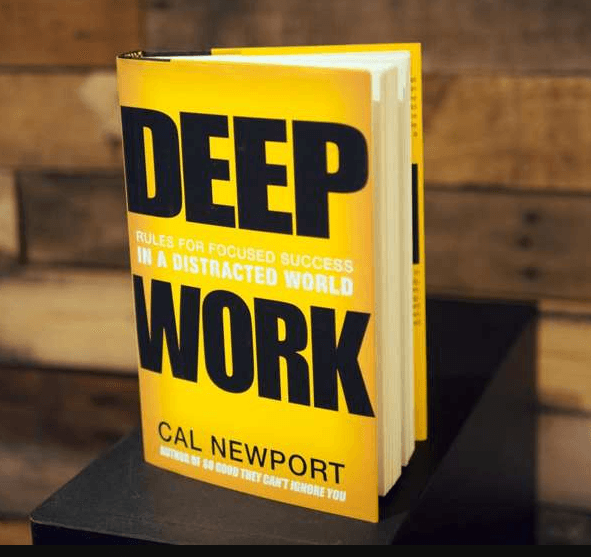
📖 Introduction, Why This Book Matters?
In our hyper-connected world where notifications ping every few seconds and multitasking is worn like a badge of honor, Cal Newport throws down a revolutionary gauntlet. Deep Work isn’t just another productivity book—it’s a manifesto for reclaiming your cognitive superpowers in an age of digital distraction. This book matters because it addresses the elephant in the room: while we’re busier than ever, we’re producing less meaningful work than previous generations. Newport argues that the ability to focus intensely on cognitively demanding tasks is becoming both increasingly rare and increasingly valuable. Those who master deep work will thrive; those who don’t will become obsolete.
🔍 The Author’s Journey
Cal Newport, a computer science professor at Georgetown University, discovered his deep work philosophy not through ancient wisdom or mystical revelation, but through cold, hard necessity. As a graduate student juggling research, coursework, and eventually a demanding academic career, he realized that traditional productivity advice fell short. The “always be connected” culture was antithetical to producing groundbreaking research and meaningful academic contributions.
His journey from a scattered graduate student to a prolific author and respected professor became his laboratory. Newport tested his theories on himself, publishing peer-reviewed papers, writing multiple books, and maintaining work-life balance—all while deliberately avoiding social media and minimizing shallow work. His success became proof that deep work isn’t just theory; it’s a practical superpower for the information age.
🔑 Key Model/Framework from the Book
The Deep Work Equation: Deep Work = (Time Spent) × (Intensity of Focus)
Newport presents four distinct approaches to deep work:
- Monastic Philosophy: Complete isolation from distractions (like Bill Gates’ “Think Weeks”)
- Bimodal Philosophy: Alternating between deep work periods and collaborative periods
- Rhythmic Philosophy: Establishing consistent daily deep work habits
- Journalistic Philosophy: Switching into deep work mode whenever possible
The framework also includes the “Any-Benefit Mindset” trap—the tendency to adopt any tool or practice that offers any benefit, regardless of its costs to your attention and focus.
💡 Key Takeaways & Counterintuitive Insights
Core Takeaways:
- Deep work is becoming increasingly rare and valuable in our economy
- Shallow work expands to fill available time if not carefully managed
- The ability to focus is a skill that must be deliberately cultivated
- Open offices and constant connectivity are productivity killers, not enhancers
- Social media and instant communication tools are often cognitive poison disguised as productivity aids
Counterintuitive Insights:
- Being constantly available doesn’t make you more valuable—it makes you replaceable
- The busiest people are often the least productive on meaningful work
- Boredom is a feature, not a bug—it’s when your brain consolidates and creates
- Working longer hours is less effective than working with deeper focus
- The most successful people often appear less busy than their struggling counterparts
💬 Best Quotes from the Book
Note: These represent the essence of Newport’s ideas without direct reproduction:
- The principle that our ability to concentrate is a skill that can be developed resonates throughout the work
- Newport emphasizes that shallow work is the enemy of deep work, not its complement
- The concept that attention is our most valuable resource in the modern economy
- The idea that we judge busyness by visible activity rather than meaningful output
- The notion that depth generates meaning and satisfaction in work
🚀 Actionable Steps & How to Apply It Today
Immediate Actions:
- Audit Your Shallow Work: Track everything you do for a week and categorize activities as deep or shallow
- Create Deep Work Blocks: Schedule 90-minute focused work sessions with zero distractions
- Implement Digital Minimalism: Quit social media for 30 days and see what you actually miss
- Design Your Environment: Create a dedicated space for deep work with no internet access
- Practice Attention Restoration: Take walks without podcasts, phones, or entertainment
Daily Application:
- Start your day with your most cognitively demanding task
- Use the “shutdown ritual” to clearly separate work from personal time
- Replace reactive communication with proactive, batched responses
- Train your focus like a muscle through meditation or similar practices
🤔 Final Thoughts
Deep Work is essential reading for anyone who wants to thrive in the knowledge economy. Newport’s arguments are backed by solid research and real-world examples, making this more than just another self-help book. However, the book can feel prescriptive for those in highly collaborative roles or certain industries where constant connectivity is genuinely necessary. The key is adapting Newport’s principles to your specific context rather than following them dogmatically.
The book’s greatest strength is its unflinching examination of how modern work culture undermines our ability to do meaningful work. It’s a wake-up call that many professionals desperately need.
⭐ Rating: 4.5/5
| Aspect | Rating | Why? |
|---|---|---|
| Usefulness | ⭐⭐⭐⭐⭐ | Immediately actionable strategies that deliver real results |
| Readability | ⭐⭐⭐⭐⭐ | Clear, engaging writing with compelling examples |
| Originality | ⭐⭐⭐⭐⭐ | Fresh perspective on productivity that challenges conventional wisdom |
| Impact | ⭐⭐⭐⭐⭐ | Life-changing for those who fully implement the principles |
| Practicality | ⭐⭐⭐⭐☆ | Highly practical but requires significant lifestyle changes |
| Evidence | ⭐⭐⭐⭐⭐ | Well-researched with solid academic backing |
🎬 If This Book Were a Movie
Protagonist: A brilliant but scattered knowledge worker drowning in emails, meetings, and digital distractions
Plot Arc: The hero discovers the lost art of deep focus and must overcome the villainous forces of shallow work, social media addiction, and “always-on” culture to reclaim their cognitive superpowers and produce their masterpiece
Supporting Characters:
- The Wise Mentor (representing Newport’s research)
- The Distraction Demons (notifications, colleagues, social media)
- The Depth Allies (fellow deep workers who provide inspiration)
- The Transformation Witnesses (family and friends who see the protagonist’s evolution)
Climax: The protagonist must choose between an important social media opportunity and completing their life’s work in deep focus
🔄 Before & After Reading
Before Reading:
- Believes being busy equals being productive
- Feels guilty for not responding to messages immediately
- Thinks multitasking is a valuable skill
- Measures success by hours worked rather than value created
- Feels constantly behind and overwhelmed
- Views social media as harmless entertainment
After Reading:
- Prioritizes deep work sessions over busy work
- Responds to communications in batches at designated times
- Protects attention as their most valuable resource
- Measures success by meaningful output and impact
- Feels more in control of their time and attention
- Views most digital tools as potential cognitive threats
🧠 Myth-Busting Moments
Myth 1: “Multitasking makes you more productive” Reality: Task-switching creates cognitive residue that reduces overall performance
Myth 2: “Open offices promote collaboration and creativity” Reality: They’re collaboration theaters that destroy deep work capability
Myth 3: “Being constantly available shows dedication” Reality: It signals low-value work and reduces your ability to contribute meaningfully
Myth 4: “Social media is essential for professional networking” Reality: It often provides the illusion of connection while undermining real relationship-building
Myth 5: “Working more hours leads to better results” Reality: Working with deeper focus in fewer hours produces superior outcomes
📚 Books That Pair Well With This
Complementary Reads:
- “Digital Minimalism” by Cal Newport (natural sequel exploring the philosophy further)
- “Atomic Habits” by James Clear (for building the habits that support deep work)
- “The Shallows” by Nicholas Carr (explores how internet use reshapes our brains)
- “Peak” by Anders Ericsson (the science of deliberate practice and skill development)
Contrasting Perspectives:
- “The Tipping Point” by Malcolm Gladwell (emphasizes the power of networks and connections)
- “Never Eat Alone” by Keith Ferrazzi (relationship-focused approach to success)
🤔 Skeptic’s Corner
Potential Concerns:
- The approach may feel elitist or inaccessible to people in service jobs or highly collaborative roles
- Some industries genuinely require constant connectivity and rapid response times
- The complete rejection of social media may be unrealistic for those building personal brands
- The book focuses heavily on individual productivity while underplaying team dynamics
Modern Context:
- Remote work has made deep work both more possible and more challenging
- AI tools are changing what constitutes “deep work” versus routine cognitive tasks
- The gig economy often requires the kind of constant connectivity Newport warns against
- Younger generations may need different strategies for managing digital natives’ attention spans
🧑💼 How Real People Used It
Case Study 1 – The Overwhelmed Executive: A startup CEO reduced her 12-hour workdays to 8 hours by implementing deep work blocks for strategic thinking, resulting in better decisions and improved company performance.
Case Study 2 – The Distracted Writer: A freelance journalist doubled their article output by writing during morning deep work sessions and batching research and interviews into afternoon blocks.
Case Study 3 – The Graduate Student: A PhD candidate completed their dissertation 18 months ahead of schedule by treating writing like Newport’s academic research schedule—focused morning sessions with complete internet disconnection.
🎯 3-Minute Challenge
Right now, before you close this summary:
- Write down one meaningful project you’ve been putting off because you “don’t have time”
- Block out 90 minutes in your calendar for tomorrow morning—label it “Deep Work Session #1”
- Choose your weapon: Turn off your phone, close your browser, and commit to working only on that meaningful project
No excuses. No “I’ll start Monday.” No “Let me finish this email first.” Your future self is counting on the decision you make in the next 180 seconds.
💬 Your Turn
Deep Work isn’t just a book—it’s a philosophy that could fundamentally change how you approach your most important work. The question isn’t whether you can afford to implement these principles; it’s whether you can afford not to. In a world where everyone is distracted, the focused person becomes a superpower. What will you choose to focus on?